If you trade the same names over and over, some of your losses are probably not deductible this year. The US wash sale rule disallows a loss when you buy the same security within 30 days before or after the sale, and moves that loss into the cost of the shares or contracts you bought back.
Your broker reports wash sales only inside its own account. A loss at one broker that you bought back at another, or in a second account at the same broker, does not show up on either 1099-B. Active option traders hit this constantly: sell a 0DTE call at a loss at 9:58, buy the same contract again at 10:12, and the first loss is washed.
The Wash Sale Report in your TradesViz trading journal screens every losing sale in the accounts you select and shows you which losses are disallowed, by how much, and which trades caused it.
Where to find it
Open your dashboard and go to Summaries > Wash Sales. The report uses the account and date filters at the top of the dashboard, so select every account you trade and the tax year you want to check. There is nothing to set up.
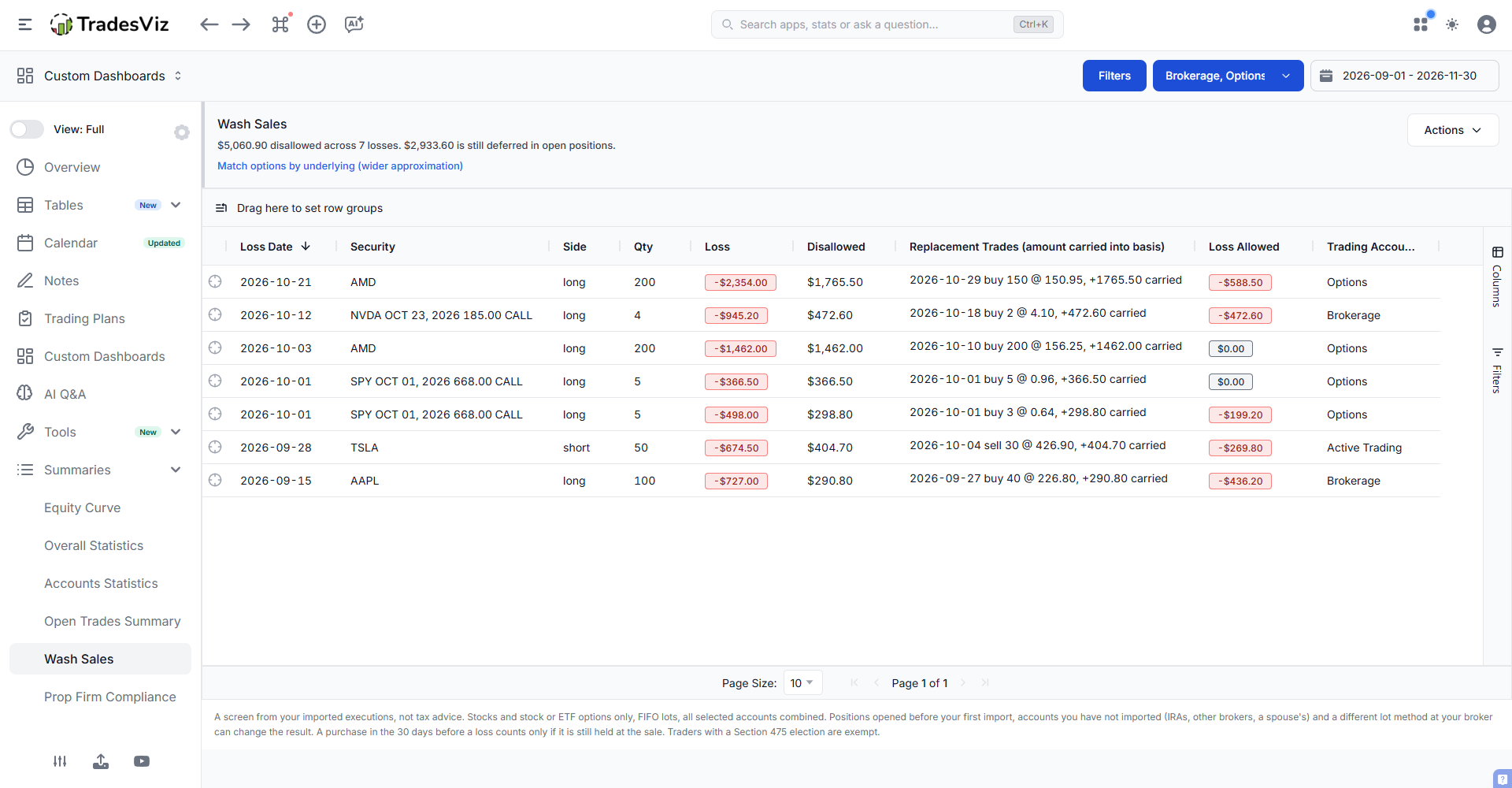
The line at the top gives you the totals: how much loss is disallowed in the selected dates, how many losing sales are affected, and how much of that loss is still sitting in positions you hold today.
Each row in the table is one losing sale:
- Loss Date, Security, Side and Qty: the closing trade that lost money. Options are listed by exact contract.
- Loss: the realized loss on that sale, including commissions and any loss carried in from an earlier wash sale.
- Disallowed: the part of the loss you cannot claim yet.
- Replacement Trades: the purchases that triggered it, with date, quantity, price and how much loss was carried into each one.
- Loss Allowed: what is left to deduct now.
- Trading Account: the account where the loss happened. Replacements can be in any selected account.
Use Actions > Export to CSV to take the table to your accountant or tax software.
How the matching works
For every closing trade at a loss, TradesViz looks for purchases of the same security from 30 calendar days before the sale to 30 days after it, across all the accounts you selected.
- Same security. Stocks and ETFs match by symbol. Options match by exact contract: same underlying, expiry, strike and call or put.
- Partial repurchases. Sell 100 shares at a loss and buy back 40, and 40% of the loss is disallowed. The rest is deductible now.
- Purchases before the sale. Shares bought in the 30 days before the losing sale count when you still hold them at the time of the sale. Shares you had already sold do not count, and neither do the unsold shares from the same purchase as the shares you sold.
- Each replacement counts once. If one purchase could replace two losses, it covers the earlier loss first.
- Short sales. Covering a short at a loss and shorting the same security again within 30 days follows the same rule.
- Expired options. An option that expired worthless is a loss like any other sale.
- Chains. The disallowed loss is added to the cost of the replacement position. If that position later closes at a loss and you buy back again, the carried loss moves forward again.
Reading the example
The screenshot above comes from three accounts over three months:
- AAPL, Sep 15: 100 shares sold for a $727.00 loss, then 40 bought back on Sep 27. $290.80 (40/100) is disallowed and added to the cost of those 40 shares. $436.20 is deductible now.
- SPY 668 call, Oct 1: 5 contracts sold at 9:58 for a $366.50 loss and the same contract bought again at 10:12. The whole loss is carried into the new position. When that position closed at a further loss, $498.00 including the carried amount, and 3 contracts were bought again, 3/5 of it was washed a second time.
- AMD, Oct 3 and Oct 21: a $1,462.00 loss washed into the next purchase, which then closed at a $2,354.00 loss that includes it. 150 of 200 shares were bought back, so $1,765.50 is still deferred in the AMD position held today.
- NVDA call, Oct 12: the loss was in the Brokerage account and the replacement contracts were bought in Active Trading. A per-broker 1099-B would not show this one.
- TSLA short, Sep 28: a 50-share short covered at a loss and 30 shares shorted again on Oct 4, so 60% of the loss is disallowed.
Match options by underlying
The IRS has not said whether an option with a different strike or expiry on the same stock is "substantially identical". The default report only treats the exact same contract as a replacement. The Match options by underlying link below the totals widens the check to any call (or any put) on the same underlying, so you can see the larger number a stricter reading would give.
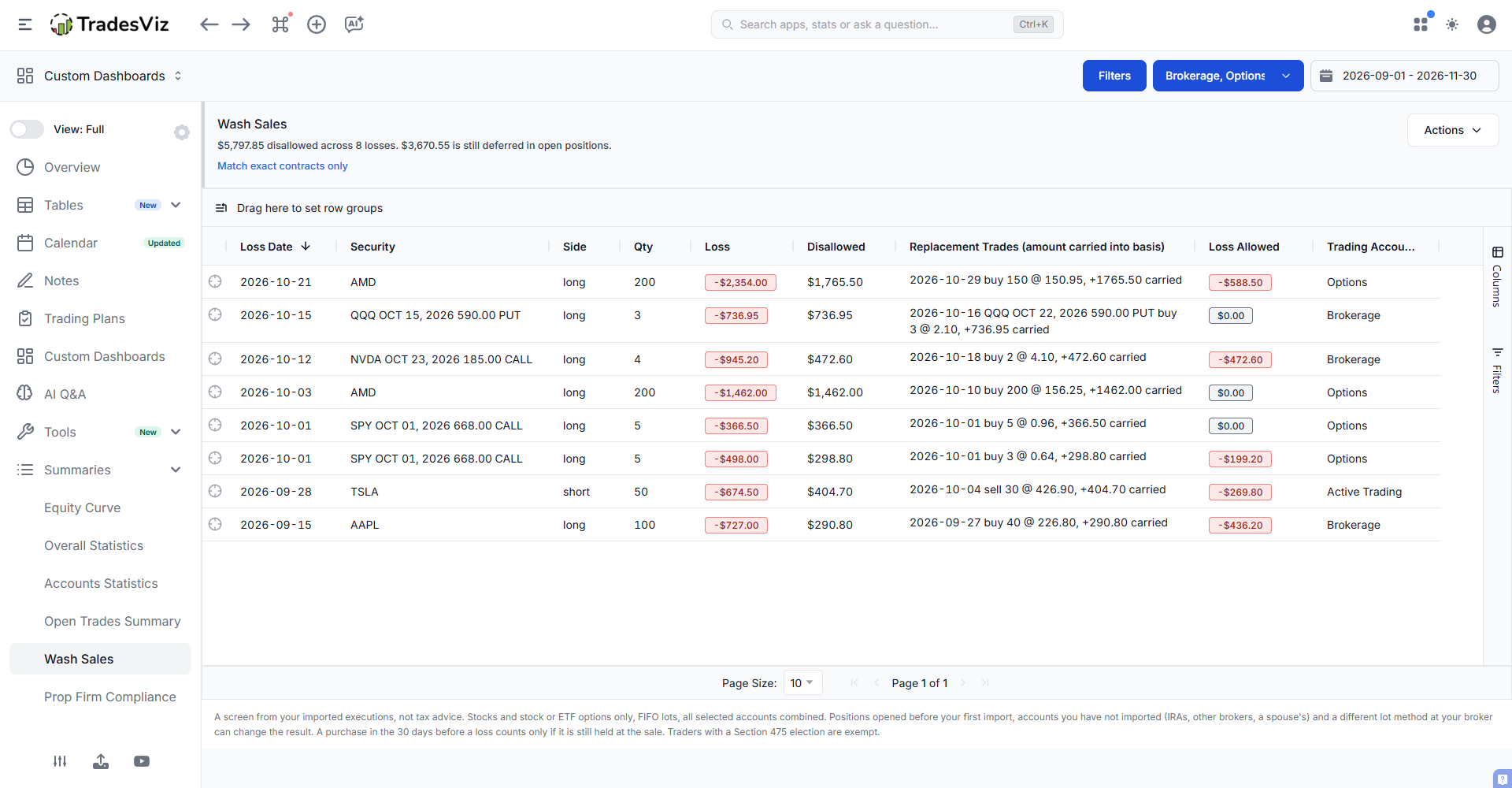
Here a QQQ 590 put that expired worthless on Oct 15 is now listed, because a QQQ 590 put with the next week's expiry was bought the following day. Calls never replace puts, in either mode.
What the report cannot see
The Wash Sale Report is a screen of the trades you have imported, not tax advice. Keep these limits in mind:
- History starts at your first imported execution. A position that was already open before that has an unknown cost basis.
- Accounts you have not imported are not checked. Purchases in an IRA, at another broker or by your spouse can wash a loss too.
- Lots are matched first in, first out. If your broker uses a different lot method, the amounts can differ.
- Stocks, ETFs and their options are checked. Futures, futures options and broad-based index options are Section 1256 contracts and are not subject to the rule.
- Traders who made a Section 475 mark-to-market election are exempt from the wash sale rule.
For the full background on the rule itself, see our glossary entry on wash sales. If you have questions or want a case handled differently, email us at [email protected].