Options Premium
An option's premium is its price. Total traded premium multiplies that price by contract quantity and the contract multiplier. In a multi-leg package, gross and signed net premium describe different aspects of the same order.
Formula
More Details
What is options premium?
An option's premium is its price. To calculate the total premium traded, multiply the option price by the contract multiplier and the number of contracts. Standard US equity options generally use a multiplier of 100; check the actual contract specifications.
Explore the product: Options Flow Features | How to Read Options Flow
A simple premium calculation
For 100 contracts priced at $2.50 with a multiplier of 100:
$2.50 × 100 × 100 = $25,000 in traded premium.
Contract count and premium answer different questions. Many inexpensive short-dated contracts can represent less premium than a smaller number of expensive long-dated contracts.
Gross versus net premium
| Measure | What it describes | What it does not establish |
|---|---|---|
| Gross premium | Total premium across the package's legs | Capital at risk or direction |
| Signed net premium | Cash debit or credit after bought and sold legs offset | Maximum risk, margin or conviction |
| Session premium | Turnover during the selected period | A position still held after clearing |
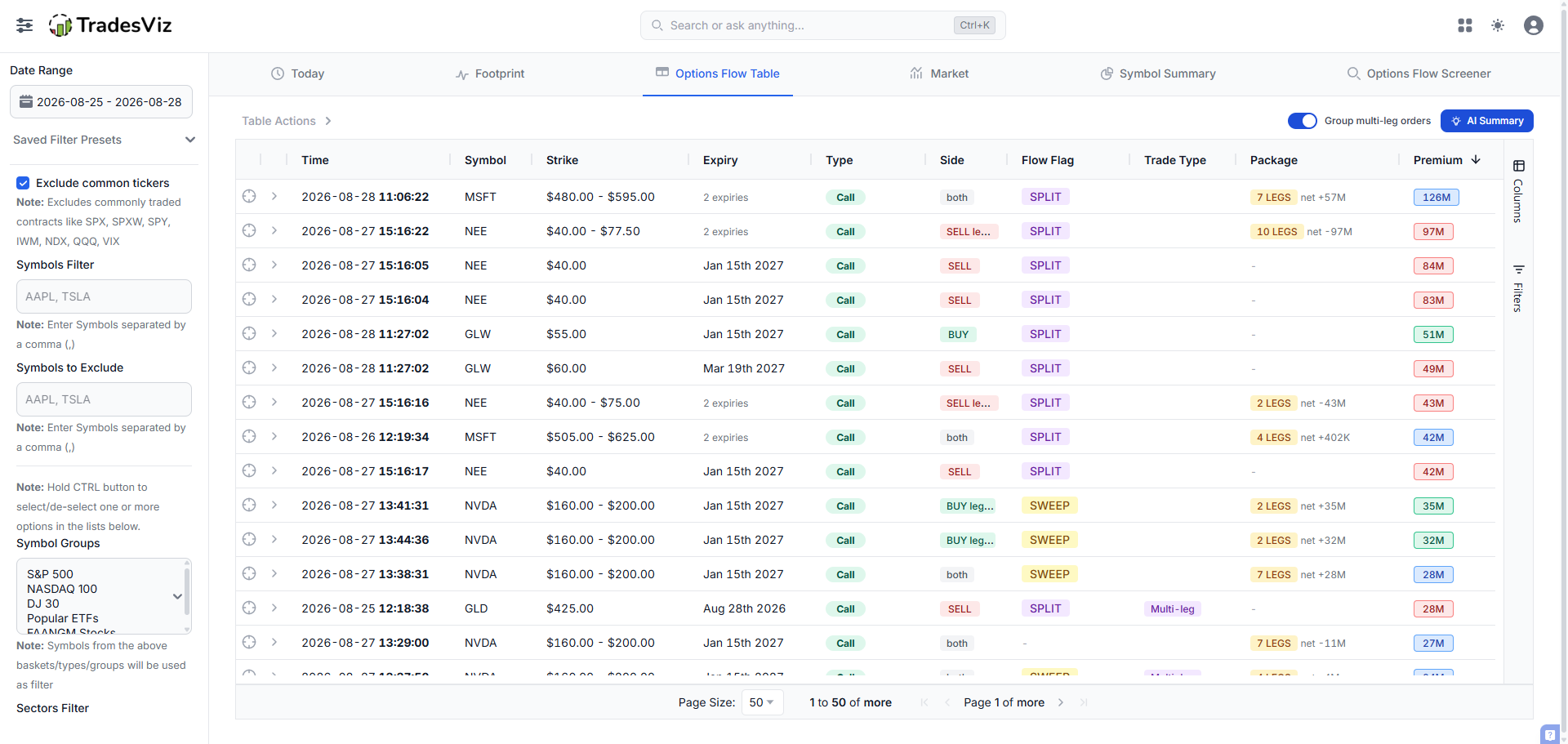
In the guide's MSFT example, seven legs across two expiries show $126M gross and +$57M signed net. Reading only the gross number loses the offsetting activity.
Use premium with structure and history
Group multi-leg orders, inspect the underlying contracts and compare the symbol with its own recent baseline. A dollar threshold can narrow your research, but it cannot identify an institution or prove that a trade is informed.
Where to find it in TradesViz
Example
100 contracts at $2.50 with a 100 multiplier produce $25,000 of traded premium. In a multi-leg package, inspect gross and signed net premium separately.