FOMO in Trading: How to Identify and Overcome Fear of Missing Out
Last updated: October 5, 2026
Spot FOMO before you enter, run a quick decision check, and measure the cost of chased trades with tags, R-multiples, and TradesViz reports.
A ticker rips through the price where you wanted to enter. You did not plan the breakout, but every new candle makes waiting feel more expensive. A few seconds later, you are in. The trade you took has worse risk than the one you first saw.
That's trading FOMO. It isn't simply buying something that is moving fast. It happens when urgency replaces your entry, size, or risk rules. A valid momentum trade can move fast. On a FOMO trade, you're making up the rules as you go.
Here's the practical version: a quick check before you click, a plan for when the move is gone, and a way to find out in TradesViz whether chasing actually costs you money. You'll still feel FOMO. That's normal. The job is to keep it from making the trade for you.
What Is FOMO in Trading?
FOMO is the urge to enter because waiting feels worse than taking a poorly defined trade. You can usually spot it in one of these changes:
- You enter at a price you would have rejected before the move started
- You can't state the invalidation level before sending the order
- You increase size to compensate for the part of the move you missed
- You switch to a ticker, market, or setup you do not normally trade
- You feel relief immediately after getting filled, even though the trade quality did not improve
A Quick FOMO Check
Before entering any unplanned mover, answer these four questions:
- Setup: What exact setup am I trading?
- Invalidation: What price proves the trade wrong?
- Risk: What is the position size at that invalidation level?
- Patience: Would I still want this trade if price stopped moving for five minutes?
If you can't answer all four without inventing the rules on the spot, the trade isn't ready. Put it on watch and wait for a fresh setup.
FOMO vs. a Valid Momentum Trade
| Decision | Valid momentum trade | FOMO trade |
|---|---|---|
| Entry | Matches a defined trigger | Chosen because price is getting away |
| Risk | Invalidation and size are known first | Stop is guessed after entry |
| Reason | Setup quality | Urgency, regret, or social proof |
| If missed | Waits for the next valid setup | Chases or adds size |
Speed is not the issue. A fast breakout that meets your rules is a valid trade. Even a slow trade can be FOMO if it makes you throw those rules away.
What Causes FOMO in Trading?
1. An Unexpected Move
A scanner alert, news spike, or sudden breakout creates a real time constraint. The mistake is treating limited time as permission to skip the setup definition. Fast markets require shorter rules, not missing rules.
2. Social Proof
Chat rooms and social feeds show you other people's entries and P&L without showing their plan, risk, or full trade history. A flood of winning screenshots can make one move feel universal even when it has nothing to do with your strategy.
3. Regret From the Last Missed Trade
After watching yesterday's setup run without you, the next mover feels like a second chance. That often lowers your entry standard. Tag this trigger separately; "missed the previous move" is more useful in a review than a generic "emotional" note.
4. A Daily P&L Target
If you believe you must make a fixed amount today, cash starts to feel like failure. That pressure gets stronger late in the session or after a slow start. A process goal, such as taking only your best setups, does not force the market to give you a trade.
5. No Plan for a Missed Entry
Most trading plans describe how to enter, but not what to do when price leaves without you. Without a missed-entry rule, every decision is improvised at the exact moment urgency is highest.
Find Your Trigger
For every FOMO-tagged trade, record what happened in the five minutes before entry: where you saw the trade, how far it had already moved, whether you had missed an earlier entry, your daily P&L, and the time. Once you have a decent batch, group the trades by those details. Work on the trigger that keeps showing up in your data.
How FOMO Affects Your Trading Performance
Your own journal will tell you far more than a market-wide statistic. Start with these three numbers:
A Simple Example
Suppose 40 planned trades average +0.25R and 10 FOMO trades average -0.45R. The planned group earns +10R; the FOMO group loses -4.5R. FOMO is only 20% of the trades, but it removes 45% of the planned-trade profit. That is a specific leak you can work on.
One small sample does not make every late entry bad. Open the trades and look at them. One outlier, a different setup, or larger position size may explain most of the result. Treat the comparison as a place to start digging, not the final answer.
How One Impulse Spreads Through the Trade
- Entry quality drops: Price has moved, so the distance to a logical invalidation is often larger.
- Risk gets distorted: You either accept a wider stop, use too much size, or place an arbitrary tight stop.
- Management becomes reactive: With no planned thesis, an ordinary pullback feels like proof that the chase was wrong.
- The exit compounds the mistake: You may panic out early or hold too long to avoid admitting the entry was poor.
A Practical Plan for the Next Time FOMO Hits
1. Mark Your Last Acceptable Entry
For each planned setup, write the trigger, the invalidation, and the highest or lowest price where the trade still makes sense. Once price crosses that line, the original setup is over. A new setup may appear later, but don't pretend it is the old one.
2. Apply a 5-Minute Rule to Unplanned Trades
If a trade was not on your plan, wait five minutes and answer the four questions above. Five minutes is not a magic number. It simply gives you enough room to define the trade before placing it. If the move is gone by then, let it go.
3. Have a Plan for a Missed Move
When price gets away, do three things: take a screenshot, mark the price where you noticed it, and set an alert at the next level that would create a valid setup. You stay engaged with the idea without paying for an impulsive entry.
4. Make the Better Choice Easy
Hide social feeds during your trading window. Use order presets based on fixed risk. Keep the four FOMO-test questions beside the order ticket. Good controls should work while you are impatient, not only when you are calm.
5. Add a Circuit Breaker
If you break the rule and take a FOMO entry, pause new entries for a preset period and tag the trade immediately. The point is to stop one bad click from turning into three more.
6. Review in Batches, Then Change One Rule
Review a batch of trades instead of rewriting the plan after one winner or loser. If the FOMO group is clearly worse, change one condition. You might decide not to trade new symbols after the first hour, then measure the next batch. Changing one thing at a time makes it easier to see what actually helped.
Copy this rule into your trading plan
If a trade is unplanned, I wait five minutes and write the setup, invalidation, and size. If I cannot define all three, I screenshot it and wait for a new setup.
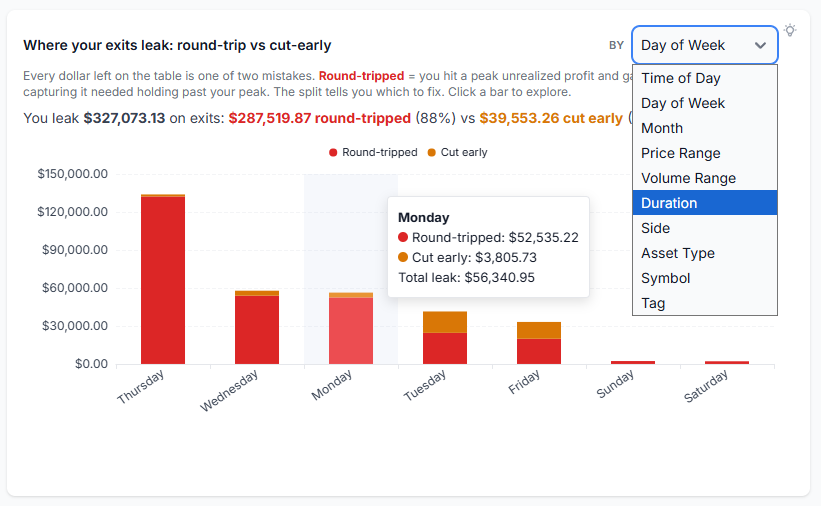
See exactly how your exits leave money behind
Exit Insights compares your real exits with Best Exit, hold-to-close, and multi-day hold scenarios. More importantly, it separates profit you had and gave back from profit that required holding longer. Those are opposite problems with opposite fixes. This chart shows which one you actually have.
Go deeper: 5 Proven Workflows to Master Your Trading Psychology
Our in-depth blog post shows exactly how to implement psychology tracking in TradesViz with real data, screenshots, and step-by-step walkthroughs. See the dollar cost of each emotional pattern and how to build your own personalized psychology dashboard.
Read the full guideHow to Track FOMO in Your Trading Journal
Step 1: Tag the Decision, Not the Outcome
Create a TradesViz tag group called Entry Process:
- Planned: Setup, invalidation, and size were defined before the trigger
- Reactive: Not planned before the session, but passed every rule before entry
- FOMO: Urgency changed the entry or made you skip a rule
- Other rule break: Unplanned for a reason other than FOMO
Tag the trade based on what you knew at entry. A FOMO trade that wins is still a FOMO trade; relabeling winners destroys the comparison.
Step 2: Tag the Trigger
Add a second group for the trigger: scanner/news, social/chat, missed earlier entry, after a loss, daily target pressure, or late-session boredom. Now you can find the situation that produces the behavior.
Step 3: Compare the Right Metrics
Filter Planned, Reactive, and FOMO trades side by side. Compare:
- Trade count and FOMO frequency
- Net P&L and average R-multiple
- Average position size and largest loss
- MAE/MFE and exit efficiency
- Time of day, symbol, setup, and trigger distribution
Use the Pivot Grid to cross Entry Process with Trigger, time of day, or setup. The total tells you how often FOMO happens. The second field shows where it clusters and where a new rule might help.
Step 4: Inspect the Trades Behind the Average
A negative FOMO average may come from one oversized loss. That still matters, but the first fix may be position size. If the results are weak across many trades, you probably need a better entry filter. If Reactive trades perform well, look at what they have in common and turn those conditions into an official setup.
Step 5: Check What Happened After Entry
FOMO at entry often creates uncertainty at exit. Filter the same tags in Exit Insights. The leak chart shows whether those trades mostly gave back open profit or were cut before the move developed. Only tell yourself to hold longer if your data shows that early exits are the real problem.
See a real FOMO cost breakdown
Our trading psychology tracking guide walks through the complete tag-and-Pivot-Grid workflow, including a trader whose FOMO-tagged trades cost $6,888 in one month. That is the difference between recording a feeling and finding a fixable leak.
Fear of Missing Out (FOMO) FAQ
What is FOMO in trading?
FOMO (Fear of Missing Out) in trading is the anxiety-driven urge to jump into a trade because you see price moving and don't want to miss the profits. It usually leads to chasing trades after they've already moved, throwing out your normal entry rules, and taking trades outside your strategy.
How do I know if I'm FOMO trading?
Use four questions before entry: What is the setup? What price invalidates it? What size fits that risk? Would I still take it if price stopped moving for five minutes? If urgency prevents you from answering any of them, the trade is probably being driven by FOMO.
Why are FOMO trades usually losers?
FOMO can worsen your entry, stretch the distance to a logical stop, distort position size, and leave you without a clear plan for managing the trade. That doesn't mean every chased trade loses. Tag the decision at entry and compare its average R, risk, and largest loss with your planned trades.
How can I stop FOMO trading?
Define a no-chase price before the session. For unplanned trades, wait five minutes and write the setup, invalidation, and size before entering. If the move is already gone, screenshot it, mark where you noticed it, and wait for a fresh setup. Tag every FOMO decision so you can review the cost in batches.
What can I do with the TradesViz REST API?
Use Python, scripts or your own applications to read and search your TradesViz accounts, trades and executions, build custom reports, and manage notes and tags. With the required permissions, you can import supported executions, edit journal entries, update trade risk settings, split or merge trades, and delete selected journal data. Execution imports currently support eligible USD US stocks and fixed-multiplier USD futures, not every asset supported by the website.
Can I connect ChatGPT or Claude to my TradesViz journal using MCP?
Yes. Connect a compatible ChatGPT, Claude or other MCP client to the hosted TradesViz MCP server using browser sign-in; no local MCP server or REST API key is needed. Ask your assistant to summarize recent trades, compare results from retrieved trades, find trades by symbol or tag, or save a review note. Editing and other journal changes require the matching permissions. Connector availability depends on your AI client and workspace settings.
How do API and MCP permissions protect my trading journal?
You select the trading accounts and permissions each API key or MCP connection can use. Start with read access and grant editing or deletion separately when needed. Day notes, day tags and general journal notes require a separate opt-in. You can revoke access from the API/MCP dashboard. These tools manage your journal; they cannot place, change or cancel broker orders. AI responses can contain mistakes, so review proposed changes before approving them.
API & MCP overview · REST API documentation · MCP connection guide · API/MCP dashboard
Related Psychology Topics
These patterns often occur together. Understanding the connections helps prevention
Track Fear of Missing Out (FOMO) in Your Trades
Use TradesViz to tag, analyze, and overcome fear of missing out (fomo). See the real P&L impact of your emotional trades.