What's your screener this Friday?
$XLE $EWZ $INTC
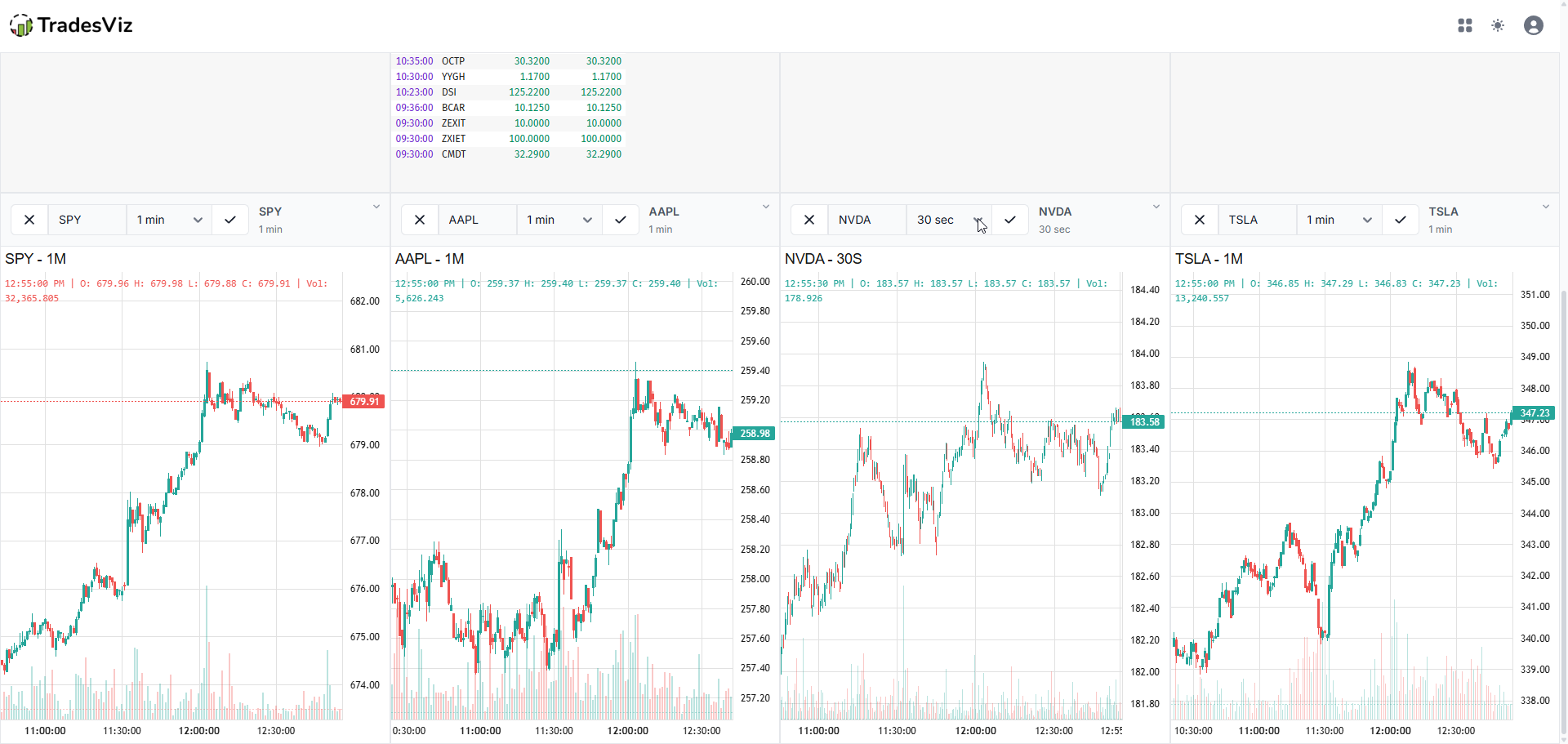
All you need is TradesViz's real-time screener to check all of this! 😎
5-sec charts, 14 screeners, unlimited screener combos and super fast charts! 👇 -- All of this is part of your TradesViz trading journal!
The April 10, 2026 screener highlighted an explosive session for momentum names and confirmed fresh technical breakouts through bullish 50–200 SMA crossovers.
In the **“More than 30% Increase”** list, $UCAR soared 332% with an extraordinary 25,000% volume spike to over 253 million shares, leading the entire board. $BBGI (+81%) and $OMEX (+50%) followed with 11‑to‑56 thousand percent volume growth, while $MGRT (+58%) and $VSIME (+44%) added breadth on sustained liquidity. The scale of volume surges in these names confirms heightened momentum and potential short‑covering.
On the **Bullish Golden Crossover** side, $DLLL (+26.8%) and $LCUT (+18.3%) led the technicals, breaking above their 50‑ and 200‑day averages on rising volume. $ACHC, $TITN, and $GIC showed strong continuation within steady trend structures, suggesting institutional accumulation rather than speculative fluctuations.
Overall, the April 10 tape signaled broad risk‑on energy — massive momentum in micro‑caps paced by clear technical confirmation in mid‑cap leaders, a constructive setup for extended Q2 continuation.
The April 10 options flow screener highlighted a sharp, three‑day surge in put/call ratios across multiple sectors — a clear sign of rising hedging demand and short‑term caution.
$MO stood out with an 11,900 percent jump to 18 on the ratio, indicating aggressive downside protection in consumer staples. Among ETFs, $XLK (+465 percent to 6.2) showed one of the most notable spikes as tech names faced renewed defensive flow. $EXPE (+1,233 percent), $SATS (+1,684 percent), and $CVNA (+1,064 percent) added to the tilt with large increases centered in discretionary and communication plays.
$MDT (+2,850 percent), $SHOP (+638 percent), and $PLTR (+398 percent) reflected broad sectoral participation as long holders rotated into protection. Even smaller‑cap and commodity names like $NUGT and $CCJ registered significant rises in put activity.
Overall, the April 10 flow underscored a temporary shift toward caution. The most notable trend was in $XLK, where the ratio’s spike suggests institutional desk hedging within mega‑cap tech after weeks of steady buying.
The April 10 options flow showed balanced but active institutional participation across financials, tech, and semiconductors — a steady continuation of measured positioning into early Q2.
Large‑cap exposure was led by $C and $TSLA, with $C printing a $29M call sweep buy ( Jun 2026 $120 ) and $TSLA recording an $18M put sweep sell at $430, highlighting two‑way engagement in high‑liquidity names. $SNDK and $MU followed in semiconductors with steady $5–8M prints, joined by $SOXX ETF buyers targeting a May 2026 bounce.
Tech names $MSFT, $META, $PLTR, and $ORCL showed mixed activity — a blend of hedging and call accumulation — while telco flow ($VZ) and utility names ($VST, $LNT) added defensive breadth. $POWL and $META registered clear Q2 re‑risking signals with $8–5M call interest each.
Overall, the April 10 flow underscored disciplined portfolio adjustment. Institutions maintained balanced exposure — sweeps signaling ongoing rotation toward tech and semiconductors while keeping protective hedges in place into mid‑April.
"I have a gut feeling about this setup." 🙄
That is exactly how accounts get blown. Before you risk a single dollar of live capital on a new strategy, you need to prove it mathematically.
The Strategy Backtester lets you hardcode your exact entry and exit rules and run them directly against historical price action.
Instantly generate a full statistical breakdown-including your Total PnL, Max Drawdown, and Sharpe Ratio-to see if your "edge" is actually an edge.
You can even review a detailed trade log and visualize the simulated executions directly on the chart.
Stop trading on hope. 🛑
Prove the math. 💻
TradesViz was the first journaling system to integrate AI in anlaysis -- back in 2023 :)
Now, the systems are far better, streamlined, more useful, and easier to use than ever.
However, they will never be a complete replacement for your manual anlaysis and exploration.
Use them effectively along with your regular analytics exploration to get more ideas on how to optimize your trading.
Stop confusing account deposits with actual trading skill. 🏦
Your raw PnL doesn't tell the whole truth if cash is constantly flowing in and out of your broker.
The Equity Curve dashboard maps your true, unvarnished capital trajectory.
Seamlessly factor in your deposits, withdrawals, and dividends to see your real growth.
You can even overlay a benchmark ticker to instantly see if your active daily grind is actually outperforming a simple buy-and-hold strategy.
Track the real bottom line. 📈
Analysis paralysis is real. 🧠
Have you tried the new Simple Overview yet?
It is the newest addition to TradesViz, designed specifically to cut through the noise.
Instead of drowning in data, you can effortlessly interchange widgets of your choice by simply searching or selecting from our massive library of charts and stats.
Build your perfect, streamlined command center in seconds.
Clean. Simple. Effective. ✨
"If only I held a little longer..." 💭
We have all said it. Now you can actually prove it.
The Stop Loss/PT Simulator runs your actual historical executions through alternate realities.
Instantly compare your Original Stats against simulated outcomes to see exactly what your PnL curve would look like if you had used a tighter stop or a wider profit target.
Stop relying on your gut feeling to manage your exits. 🛑
Mathematically optimize your risk. 🧮