Your trading journal records what happened on each trade. A weekly review helps you see the patterns across those trades: which days contributed most, where losses accumulated, and whether you followed the plans and rules you had set.
TradesViz Weekly View brings weekly trading performance, realized drawdown, trade activity, and review notes onto one page. You can compare several weeks, investigate a result, and record one action for the next period. The same tools also support a monthly trading review.
Open Weekly View in your trading journal
Open Calendar in the sidebar and select Week in the main Day, Week, Month, and Year navigation. Weekly performance, saved reviews, and the rules summary are available on Pro and Platinum. The trading-plan coverage section requires Platinum.
Choose your trading accounts, date range, and trade filters, then use Show to display the latest 12, 26, or 52 periods, or all periods in the filtered range. Twelve weeks gives you a starting point for comparing recent results without losing sight of individual weeks.
Weeks begin on Monday. A current week, or one cut short by your date filter, is marked as partial. Weeks without trading activity remain visible.
Compare weekly trading performance
The summary cards help you read the results before opening individual trades:
- Realized P&L totals all displayed periods, including partial periods. The label follows your gross or net P&L setting.
- Profitable weeks counts completed active weeks with positive P&L, out of all completed active weeks.
- Median week P&L shows the middle result among completed active weeks, putting unusually large gains or losses in context.
- Worst week P&L shows the lowest result among those completed active weeks.
Quiet weeks and partial periods are excluded from the profitable-week count, median, and worst-week comparison. Total displayed P&L still includes partial periods, so the summary's active-week count can be smaller than the number of weeks in the charts.
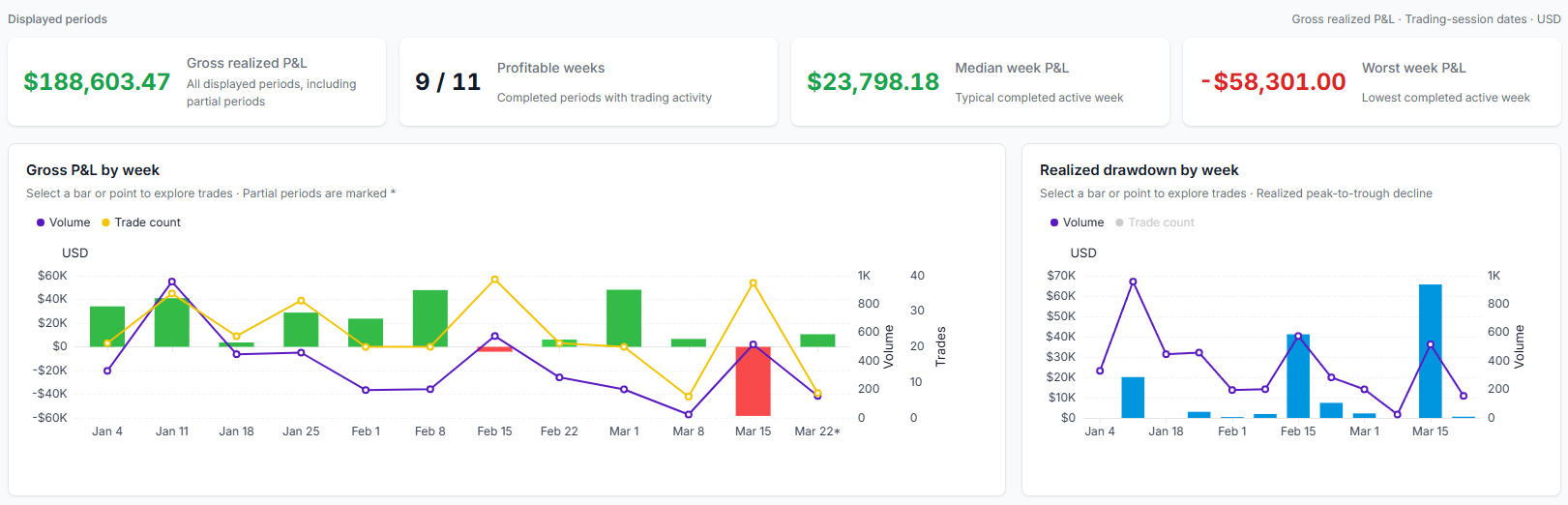
Read the weekly result alongside drawdown and trading activity. The legend controls let you choose which overlays to display. Select any screenshot in this guide to open it at full size.
Read P&L alongside drawdown and trading activity
The P&L by week chart uses green and red bars for each period's realized result. Realized drawdown by week shows the largest peak-to-trough decline along that period's realized execution P&L path.
Two weeks can finish with similar profits but have very different declines along the way. Comparing the charts helps you find periods worth investigating in your trading journal.
Realized drawdown starts from zero within each period and follows executions, rather than only end-of-day totals. It excludes unrealized P&L and does not measure the full account drawdown across several weeks.
Add volume and trade count from the legend
Both charts include Volume and Trade count toggles. They start disabled. Click a legend label to show its line, and click again to hide it. Each chart has independent toggles and separate axes for activity.
- Volume adds up absolute execution quantities, including entries and exits. It supports fractional quantities and measures traded units rather than dollar turnover. Use account and instrument filters when comparing assets with different units.
- Trade count counts each trade with executions in the period once, even if it has several fills. It differs from execution count and from the number of trades that closed during that period.
These calculations use the closed trades matching your filters. The overlays show executions belonging to those trades, rather than an inventory of currently open positions.
Open the trades behind a chart point
Hover over a bar or point for its values. Click a bar or overlay point to select a period and open its trades in Chart Explore. This connects a change in the weekly chart with the trade log behind it.
The example below shows a selected week alongside its trades. From there, you can inspect symbols, entry and exit timestamps, P&L, executions, and other trade details. Click a chart's empty background to open the larger chart view, or use its range controls when working with a longer history.
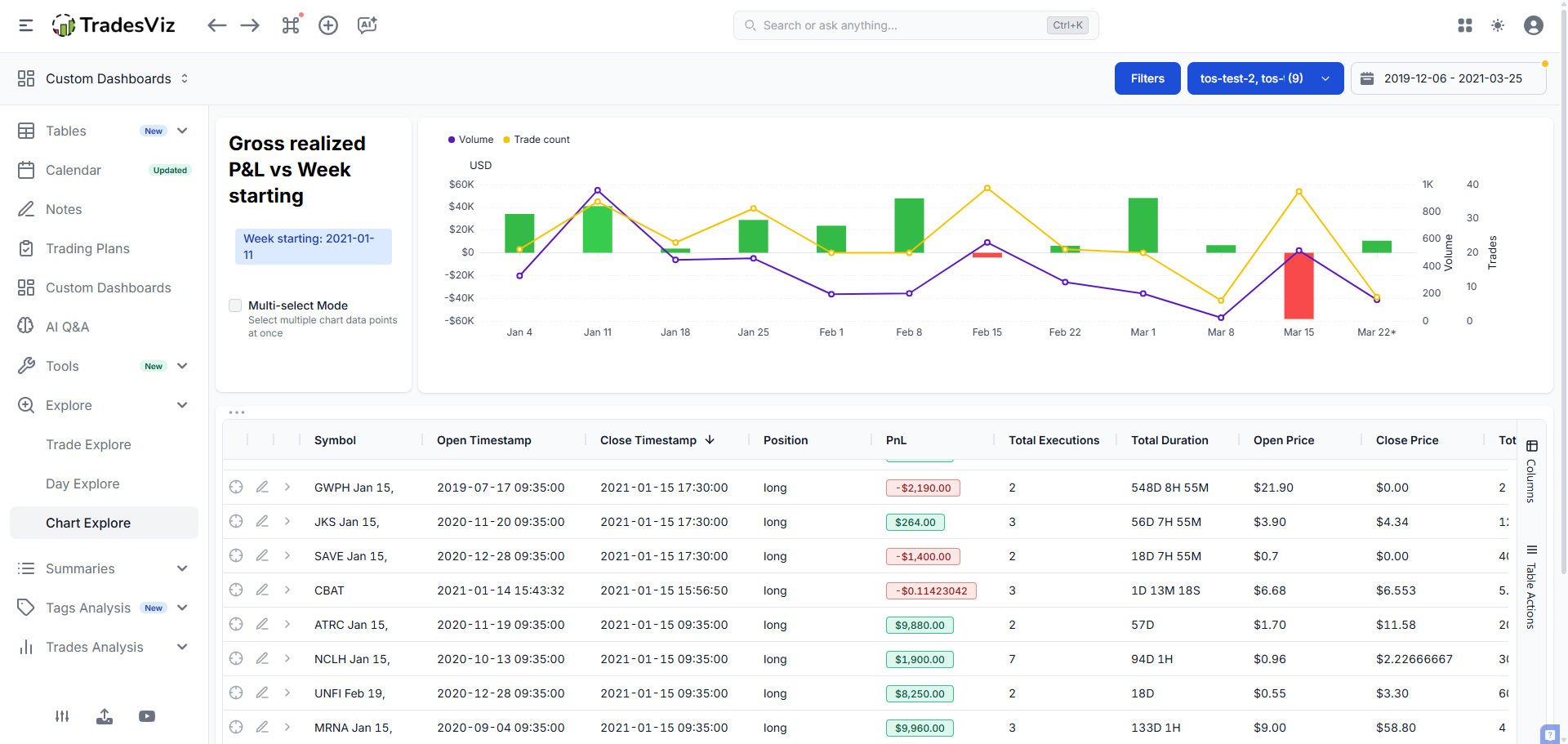
Open a week from the chart to inspect the trades behind its performance. The selected period remains visible beside the chart.
Find useful comparisons in the weekly table
The Weekly comparison table puts realized P&L, closed trades, expectancy, profit factor, maximum realized drawdown, and change versus the prior period together. Sort a column to find large gains, losing weeks, or periods with greater drawdown. Use the column controls to adjust the table and select a row to load its review.
Expectancy is the average full outcome of trades that closed in the period. Profit factor compares their total winning P&L with the absolute value of their total losing P&L. Read both alongside the number of closed trades, especially when a week contains only a few trades.
Change vs prior is the difference in realized P&L from the preceding period, expressed as an amount. It is unavailable when either period is partial.
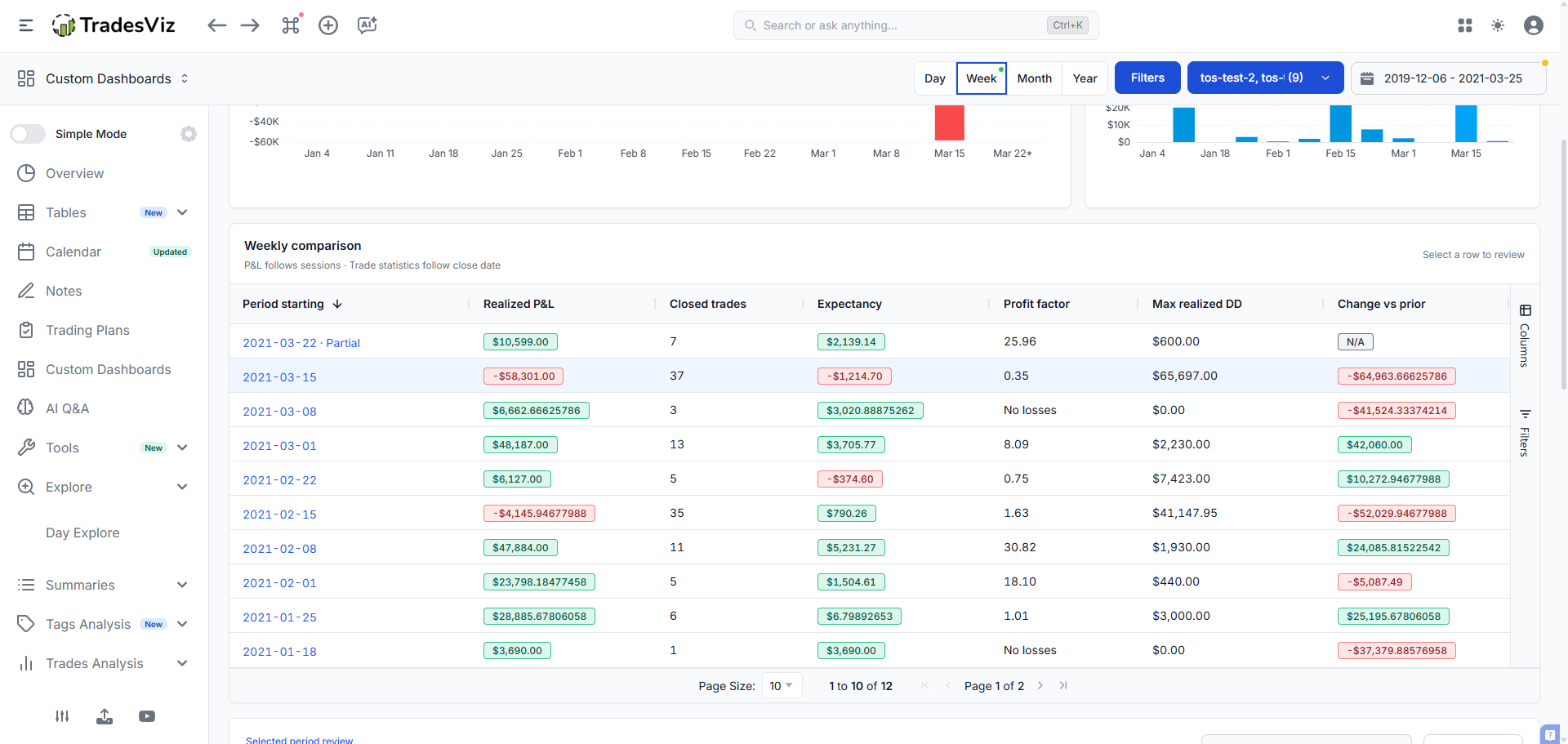
Compare periods in one table, then select a week to review its daily results, symbol contributions, and trading process.
Find the days and symbols behind your results
Choose a table row or use the dropdown in Selected period review. The date range and adjacent P&L value identify the period. Explore trades opens its underlying trades.
The statistics strip shows closed trades, expectancy, profit factor, win rate, maximum realized drawdown, and commissions plus fees. The win-rate detail also includes average win and average loss. Breakeven trades are included in the closed-trade count used for win rate.
Costs stay visible in both P&L modes. In gross mode, they have not been deducted from the reported result. In net mode, they are already included, so do not subtract them again.
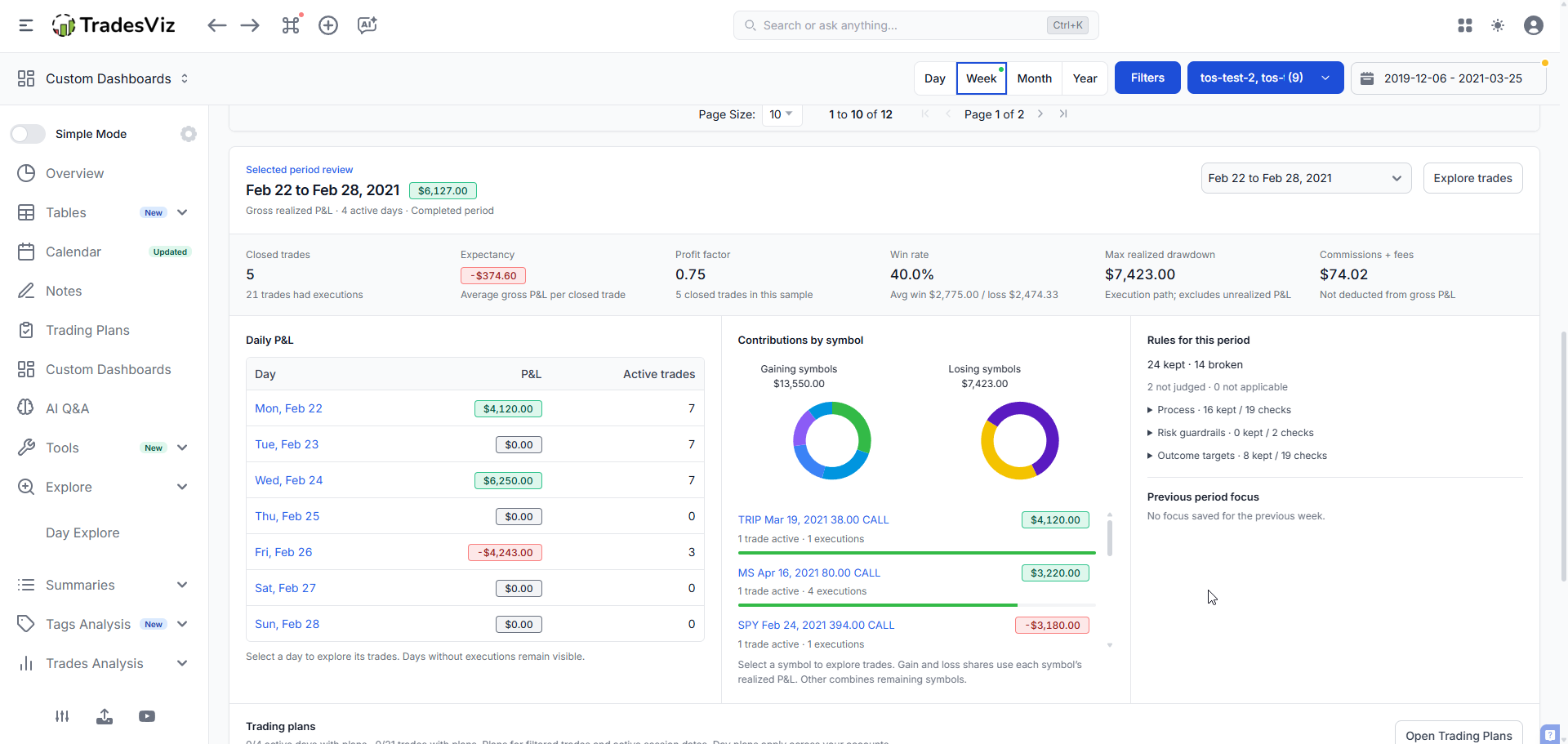
The selected-period review connects the week's numbers with individual days, symbols, and rule checks.
Review daily P&L
The daily table lists each day, its P&L, and its active trade count. Select a date to open Day Explore. Days without executions remain visible with zero values; days outside your date range are marked as unavailable. The table scrolls for longer monthly reviews.
A zero P&L day can still have trading activity. In the example above, February 23 shows zero P&L with seven active trades, while February 25 shows zero P&L and no active trades. The extra column helps distinguish those situations.
See contributions by symbol
Separate doughnut charts show the gaining and losing symbol contributions. Each symbol's contribution is based on its combined realized P&L for the period. For options, the symbol can be the individual contract.
The largest eight symbols by absolute P&L appear individually, with the remainder combined into Other. Click an individual symbol or doughnut slice to explore its trades. Other combines the remaining symbols and does not have its own drill-down.
If one symbol accounts for much of a profitable week, open it to see whether that contribution came from one trade or several. The scrollable list keeps this analysis readable even when you traded many symbols.
Review trading rules alongside P&L
Rules for this period brings your configured daily checks and the applicable weekly or monthly checks into the review. They are grouped into Process, Risk guardrails, and Outcome targets.
Expand a group to see individual rules, their dates, and whether each check was kept, broken, not judged, or not applicable. Where available, select Review day to inspect that day's trades.
These are counts of rule checks: a daily rule can appear on several days. Partial periods are not judged, and missing measurements can also prevent a verdict. An unavailable judgment is not counted as a successful check.
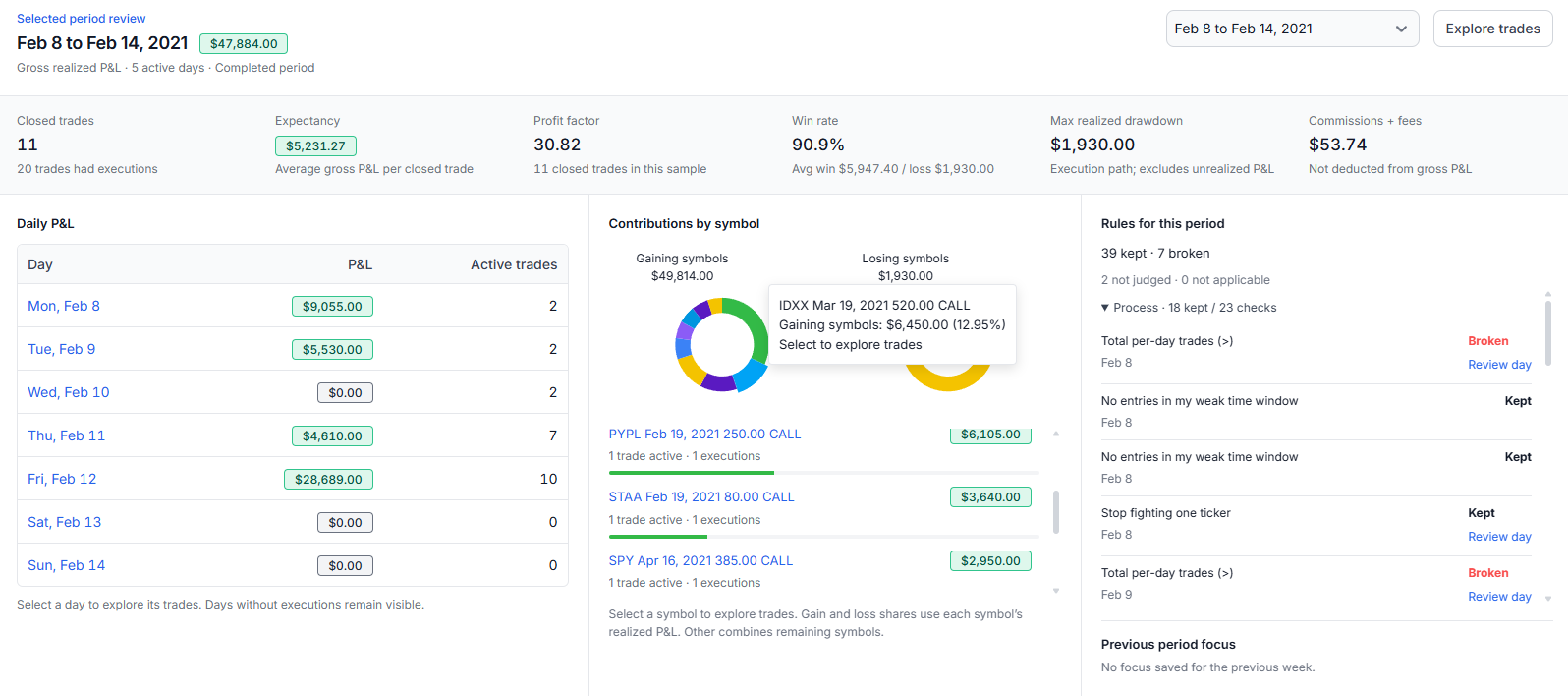
A profitable week can still include broken process rules. Expand the checks and open the relevant days to understand the decisions behind the result.
Use the Trading Rules guide to configure checks that reflect your own trading process.
Connect day plans and trade plans to your review
On Platinum, the plans section shows how many active days and trades matching your filters have attached plans. Missing-plan links let you open the existing day or trade editor and add a plan.
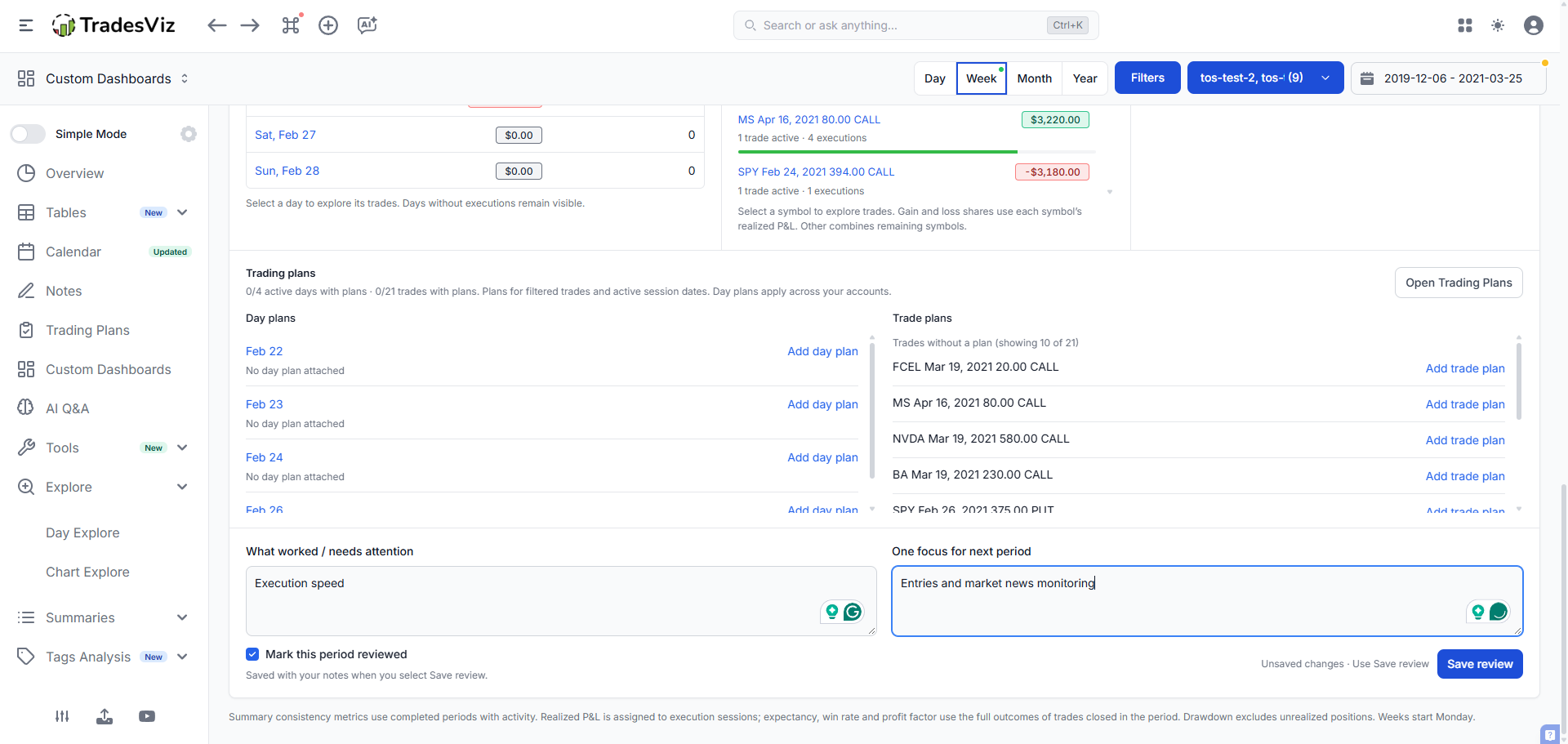
The missing-plan list makes gaps visible and provides direct links to add day or trade plans.
Once plans are attached, the summary also shows how many checklist checkboxes were answered, kept, or broken. Coverage and completion are separate: a day can have a plan attached while some questions remain unanswered.
The panel shows examples of missing plans, so a large period's displayed list can be shorter than its total coverage count. Day plans apply across your accounts, while trade plans belong to individual trades. Saved reviews, rule checks, and plan coverage in this view use accounts you own.
Open the plan behind a day or trade
Select a plan's review link to read its answers in the existing editor. Plans can include context for your trading decisions as well as checklist items. The Wellness Report below records sleep, stress, and mood, adding trading psychology notes to the review.
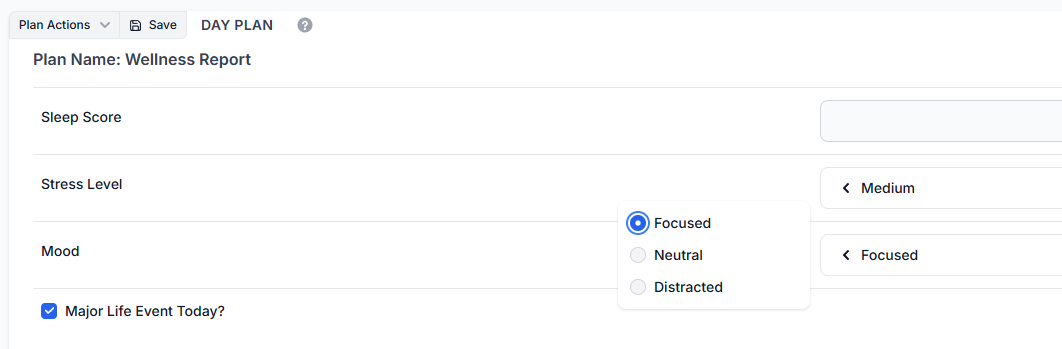
A day plan can record personal context alongside your trading checklist. Review the original answers when reflecting on that day's decisions.
Start with the Trading Plan checklist guide or browse trading plan examples to build a plan that fits your workflow.
Save your weekly trading review
Use What worked / needs attention to connect your trading performance with your decisions. In One focus for next period, choose a specific action you can revisit, such as checking the day's market events before your first trade.
Select Mark this period reviewed, then click Save review. The text and checkbox save together. Checking the box alone does not save the review, lock the period, or change its statistics.
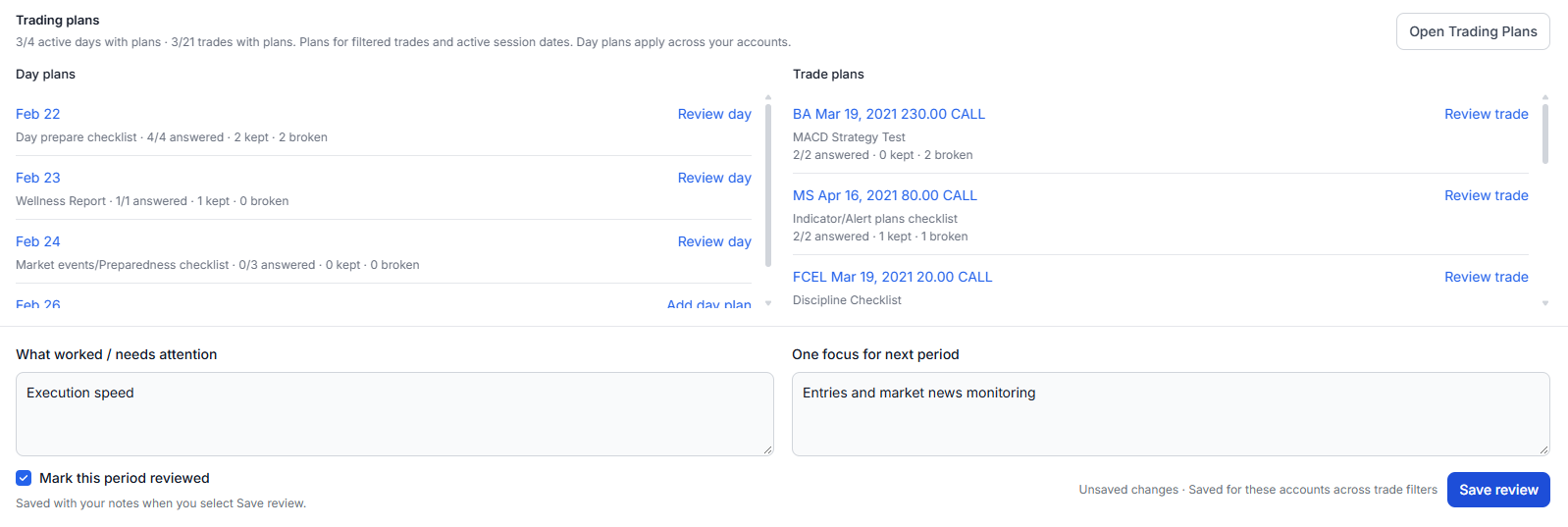
Plan coverage and review notes sit together at the end of the workflow. This example contains unsaved edits; select Save review to store the notes and reviewed status.
Wait for the saved confirmation before leaving or refreshing. Your review is stored in your TradesViz account for that week or month and the selected combination of trading accounts. Changing trade filters or gross/net P&L mode does not create a separate review for the same period and accounts. Choosing a different account combination does.
Previous period focus brings forward the saved focus from the immediately preceding week or month for the same accounts. Reviews also appear in Notes; return to Weekly View to edit the reflection, next-period focus, and reviewed status.
Use the same workflow for a monthly trading review
Select Month inside the performance page to group the charts, comparisons, and review by month. The labels and period choices update, and you can save a separate monthly reflection and next-month focus.
This inner switch differs from the main navigation's Month button, which opens the monthly trading calendar. Use the performance page to compare whole months and the calendar to browse individual days.
Understand session P&L and closed-trade statistics
Weekly P&L follows trading-session dates. Closed-trade count, expectancy, win rate, and profit factor use the full outcomes of trades that closed in the period. A trade with executions across several weeks can therefore contribute to session P&L in a different week from its closed-trade statistics.
The February 22 to 28 screenshot illustrates this: realized session P&L is positive at $6,127, while expectancy is negative. The metrics describe different parts of the trading history, so multiplying closed trades by expectancy does not necessarily reproduce the week's session P&L.
Keep the account selection, date range, trade filters, and gross/net mode consistent when comparing periods. Treat partial periods as work in progress and read small samples alongside their trade counts.
Build a repeatable trading journal review routine
- Set the scope. Choose your accounts, filters, and a completed week.
- Compare the result and drawdown. Add Volume or Trade count when activity needs context.
- Investigate the contributors. Open the days, symbols, and trades behind the biggest changes.
- Check your process. Review broken or unjudged rules, missing plans, and unanswered checkboxes.
- Save one next step. Write your reflection, choose a focus, mark the period reviewed, and save.
Open your TradesViz trading journal and select Calendar > Week to review your own trading history. For help or feedback, contact [email protected].