
TradesViz
Raw data ignores your state of mind. The Notes module acts as your clinical trading journal. Deploy structured tilt-reset worksheets to defuse emotional execution. Master your mindset alongside your mechanics. 🧠

TradesViz
Raw data ignores your state of mind. The Notes module acts as your clinical trading journal. Deploy structured tilt-reset worksheets to defuse emotional execution. Master your mindset alongside your mechanics. 🧠
TradesViz
Isolated metrics hide your creeping bad habits. Trend Analysis exposes your true behavioral trajectory. Track moving averages of your volume across your trade history. Visualize toxic size creep before it destroys your account. Stop ignoring the macro trend. Protect your edge. 📉

TradesViz
Gut feelings don't print money. Trade Analysis brutally dissects your true profitability. Map your PnL directly against specific hold durations. Let AI instantly expose your most toxic timeframes. Stop guessing. Prove your edge today. 📊

TradesViz
Look at that signal history trend of $CRM 👀 All of this is trackable on TradesViz's new improved options flow dashboard... What more do you need in terms of ideas and solid, reliable data? :) Learn to analyze and find signals - no AI can/will do it for you reliably...

TradesViz
On September 17, 2026, the stock screener highlighted robust uptrends. $QBTZ led with a 385.4% increase over 14 days despite an 83.4% drop in volume, indicating strong price resilience. $RKLZ also surged 375.1%, maintaining interest despite an 80.4% volume decrease. In continuous volume growth, $VEEA stood out with a 267.5% price rise and a 91,060.8% volume surge, showcasing heightened market activity. $FPSX and $TGMR also showed strong volume increases, reflecting strategic positioning.

TradesViz
On September 17, 2026, the options flow screener showed notable split sell activity in major stocks. $CRM led with a 400% increase, indicating heavy selling pressure. $AMZN and $SPCX were also prominent, with rises of 75.88% and 185.56%, respectively. Other significant movements included $CVNA at 87.74% and $MSTR at 75.3%, highlighting strategic adjustments. The chart for $AMZN reflects these dynamics, underscoring shifts in market positioning.

TradesViz
On September 17, 2026, options flow analysis highlighted contrasting trends. $COST faced sustained bearish sentiment with 12 consecutive sessions of net bearish flow, totaling a gross of $44.1M. A net sell of $19M across 152 contracts and 19 expiries, indicating persistent selling pressure. Conversely, $MTUM displayed bullish momentum for seven straight sessions, accumulating a $342K gross and a $280K net across five contracts and four expiries, suggesting strong market interest.

TradesViz
On September 17, 2026, options flow for $CRM revealed substantial split call activity set to expire on September 18. The largest block involved a $200 strike call with a $90M premium, reflecting significant selling pressure. Additional heavy sell legs were seen at the $175, $195, and $210 strikes. In contrast, $AAPL showed bullish sentiment with call buying at the $140 strike, expiring October 18, with a $19M premium.

TradesViz
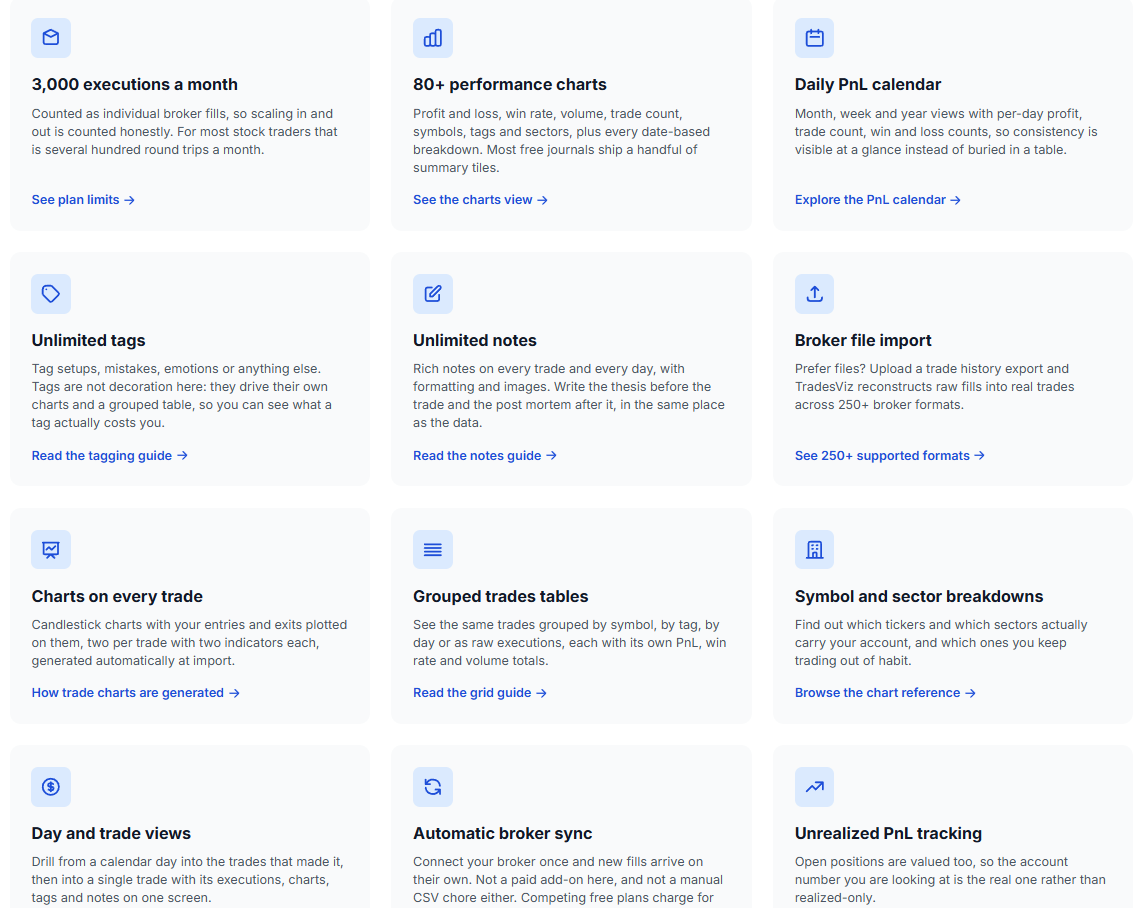
Looking for a free journaling solution? Try TradesViz. When a journal is free because nobody is funding that work, you are the one paying. In broken imports, in numbers you cannot trust, and eventually in an abandoned product with your trading history locked inside it. TradesViz has an extensive free tier because some users choose to upgrade, and that pays for our costs. Costs include development, data, infrastructure, continuous maintenance, support, research, and security. Next time you build your own "free" journal, think about how much your time is worth to you :) ...or you decide to use a "free online journal" that was released 1 week ago, think twice about where you are spending your time and efforts.
TradesViz
Every rule is scored against your past, immediately. This is the new rules system on TradesViz. Prove your discipline: The answer to "would this rule actually have helped me?" arrives before you have followed it even once. Adopt a template, and its streak, its calendar markers, and its adherence numbers are already there to read.
