Last update: Nov 2026
Trades Compare answers questions about your trading from your own closed trades. Start with a prepared question, such as longs against shorts or what changes after a loss, or describe two groups in your own words with AI-assisted comparison. AI helps define the groups, and TradesViz calculates the results from the trades that match. Every answer shows how many trades it is based on.
Compare first launched in 2020 as a filter group builder in your TradesViz trading journal. That builder is still here, now under Custom comparison. The Nov 2026 update adds prepared questions, AI-assisted comparisons, tracking on new trades, saved reports with quick stats, trades side by side and comparable trade history.
You can compare two specific groups, such as AAPL longs entered before 10 AM against TSLA longs entered after 2 PM. You can also compare one group against the rest of the selected view. The text box is not limited to the prepared question list.
What is new in this update
- Prepared questions: 9 core questions and 7 Platinum questions, answered from your trades the moment you open the page. The clearest differences come first.
- AI-assisted comparison: describe two groups using symbols, sides, entry times, weekdays, dates, accounts or tags. AI builds the group definitions from your question.
- Plain labels: Clear so far, Not clear yet, Too few trades and No label, so a gap from a handful of lucky trades does not look like a finding.
- Tracking: follow eligible prepared comparisons on trades you take from now on and see whether the difference persists, weakens or reverses.
- Saved reports: rolling reports that update, snapshots that keep their numbers, and cards showing each group's trade count, win rate and P&L.
- Trades side by side: entry, exit, size, fees, stop, target, tags and notes for up to 4 trades in one table.
- Comparable trades: see how one trade did against your own similar trades.
- Make a rule: turn a clear difference into a draft for Trading Rules.
- Compare everywhere: start a comparison from AI Coach Trading Review, the calendar, any chart, the trades table, AI Chat and AI Query.
Pro and Platinum
Compare is part of Pro and Platinum. Both plans include AI-assisted comparisons and the manual filter group builder. Platinum opens the full prepared question library and adds the deeper questions.
| Feature | Pro | Platinum |
|---|---|---|
| New AI-assisted comparisons per day | 10 | 30 |
| Prepared questions with full answers | The best 3 for your view | All of them |
| Plan, rule, simulator, option expiry, market condition, exit and period change questions | No | Yes |
| Tracked comparisons | 1, checked weekly | 10, checked after each sync |
| Saved reports | 5 | 50 |
| Trades side by side | 2 | 4 |
| Comparable trades and synced charts | No | Yes |
| Make a rule | Rules that cover all your trades | Also rules for one group of trades |
| Custom comparison | Up to 10 filter groups | Up to 10 filter groups |
The daily AI comparison allowance is separate from AI Q&A. Prepared questions, manual filter groups and reopening saved reports do not use it. The AI add-on does not change these comparison limits.
Opening Compare
Click Compare in the dashboard sidebar. It opens in its own browser tab, so you can keep your dashboard open next to it. If you are logged in you can also go straight to tradesviz.com/compare.
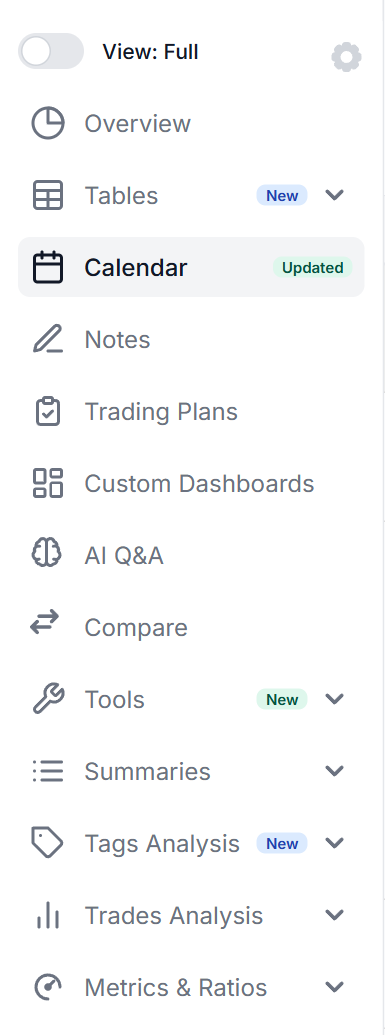
The Compare sidebar has these sections:
- Questions: prepared questions and the AI-assisted comparison box. This is where you land.
- Tracked and saved: your tracked comparisons and saved reports.
- Trades side by side: appears once you open trades side by side.
- Custom comparison and Filter Groups: the filter group builder.
- Groups Statistics, Trades Analysis and Metrics & Ratios: appear after you generate charts for two or more groups.
Choosing a view
Three controls at the top decide which trades every question uses:
- Accounts: any mix of your trading accounts. Sample trades are left out once you have real accounts.
- Period: all time, the last 12 months, the last 6 months or the last 90 days.
- P&L: net of fees, or before fees.
Below them, the three strongest answers appear as cards and the rest sit under More questions. Click any question to open its answer.
AI-assisted comparisons
Use the AI-assisted comparison box below the prepared questions when you want to choose the groups yourself. You can combine conditions in one request, and the two groups can use different conditions. For example, compare Monday longs with Tuesday shorts, or compare the same symbol at two different times of day.
- Choose the accounts, period and P&L setting. These define the available trades. If your question concerns 2023, choose All time so that those trades are included.
- Describe both groups and click Compare. Be specific about symbols, entry or exit times, weekdays and dates. Times use your journal's configured timezone.
- Follow the progress loader. It shows the current step, percentage and elapsed time while AI defines the groups and TradesViz prepares the results.
- Review How these groups were selected. Check that both definitions match what you meant, then compare trade counts, win rates, P&L and the result per trade.
- Save or explore the comparison. Keep a rolling report or snapshot, or choose All charts for these groups for the full analysis.
Example questions to try
Use symbols, account names and tags that exist in your journal. These examples specify the groups; the results depend on your own trades.
| Question | What the two groups contain |
|---|---|
| Compare my ES trades opened on Mondays with my ES trades opened on Fridays. | ES entries on two weekdays, keeping the symbol the same. Other weekdays are left out. |
| Compare long trades opened on Mondays with short trades opened on Tuesdays during 2023. | Monday long entries vs Tuesday short entries in 2023. Other weekdays and sides are left out. |
| Compare my AAPL longs entered before 10 AM with my TSLA longs entered after 2 PM. | AAPL long entries before 10:00 vs TSLA long entries after 14:00, within the selected period. |
| Compare my SPY trades entered before noon with my SPY trades entered at or after noon. | The same symbol split by entry time, without mixing in your other symbols. |
| Compare trades tagged Breakout with trades without the Breakout tag. | Trades with that tag vs every other trade in the selected view, including untagged trades. |
| Compare my long trades in Account A with my long trades in Account B. | Longs in two named accounts. Select both accounts above and replace the names with your own. |
Start with one difference you want to investigate. For example, the SPY morning-versus-afternoon question keeps the symbol fixed, while the AAPL-versus-TSLA example changes both symbol and time. Both comparisons are valid, but they answer different questions.
Example: ES trades on Mondays vs Fridays
The screenshot below shows the result of comparing ES trades on two weekdays. Each group has its own trade count, trading days, average result per trade, total P&L and win rate.
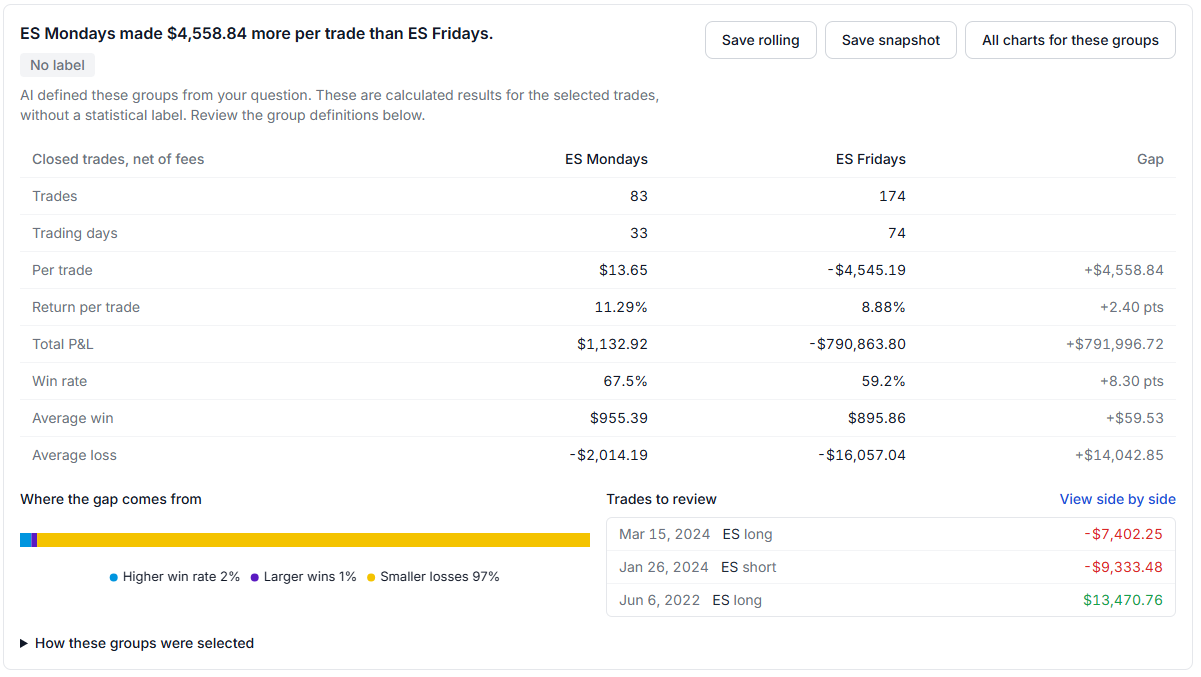
Here, the Monday group has 83 trades and the Friday group has 174. The win rates are 67.5% and 59.2%, but Where the gap comes from shows that smaller average losses account for most of the difference in the result per trade. This is why the answer includes average wins and losses alongside win rate. These figures describe the trades in this screenshot, not an expected result for other ES trades.
Example: groups with different conditions
The two groups can differ in more than one way. You could compare short trades opened in the first quarter with long option trades opened in the fourth quarter, then add a price or quantity condition to the question if that is part of what you want to study.
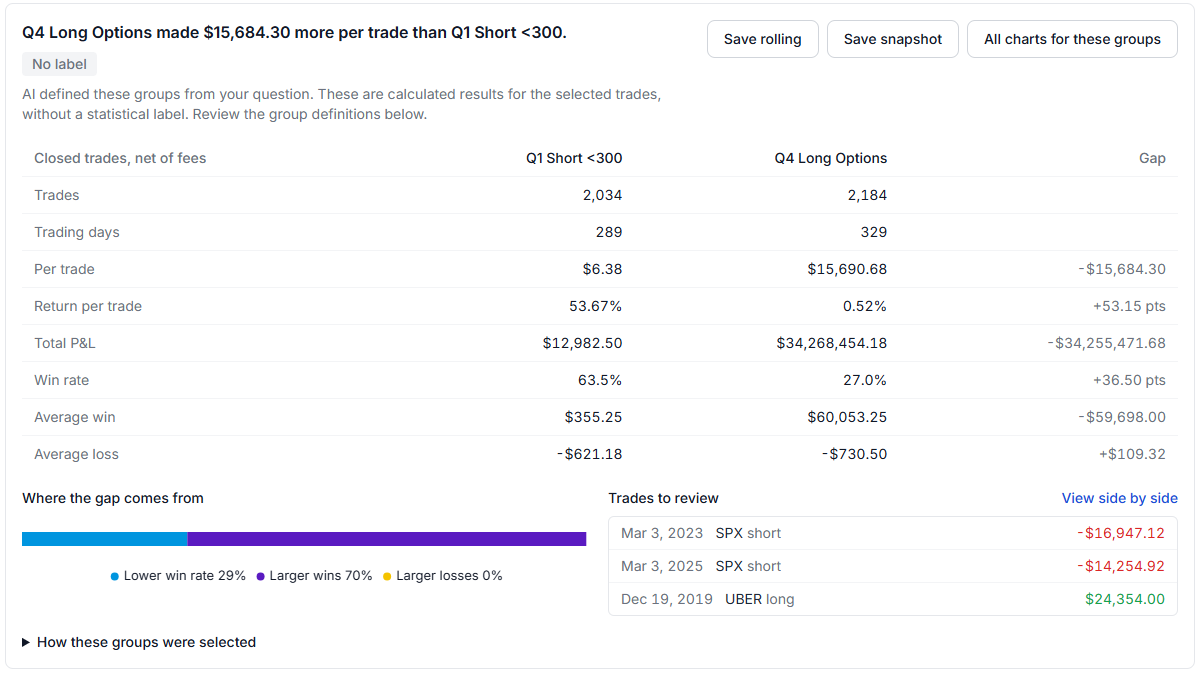
In this example, Q4 Long Options has a lower win rate than Q1 Short <300, but a much larger average win. A higher win rate alone does not tell the whole story. Open How these groups were selected to read the full conditions behind the short group names.
What AI does, and what the result means
AI translates your request into two group definitions. The statistics are calculated from your actual closed trades. A question can narrow the accounts and period you selected, but it cannot bring in trades outside that view. If the groups overlap, the request is unclear or the required data is unavailable, Compare asks you to clarify or rephrase.
AI-assisted results show No label. You chose the conditions, so the numbers do not receive the statistical verdict used for prepared questions. These comparisons can be saved and opened in full charts, but they do not offer Track on new trades or an automatic Make a rule action.
Reading an answer
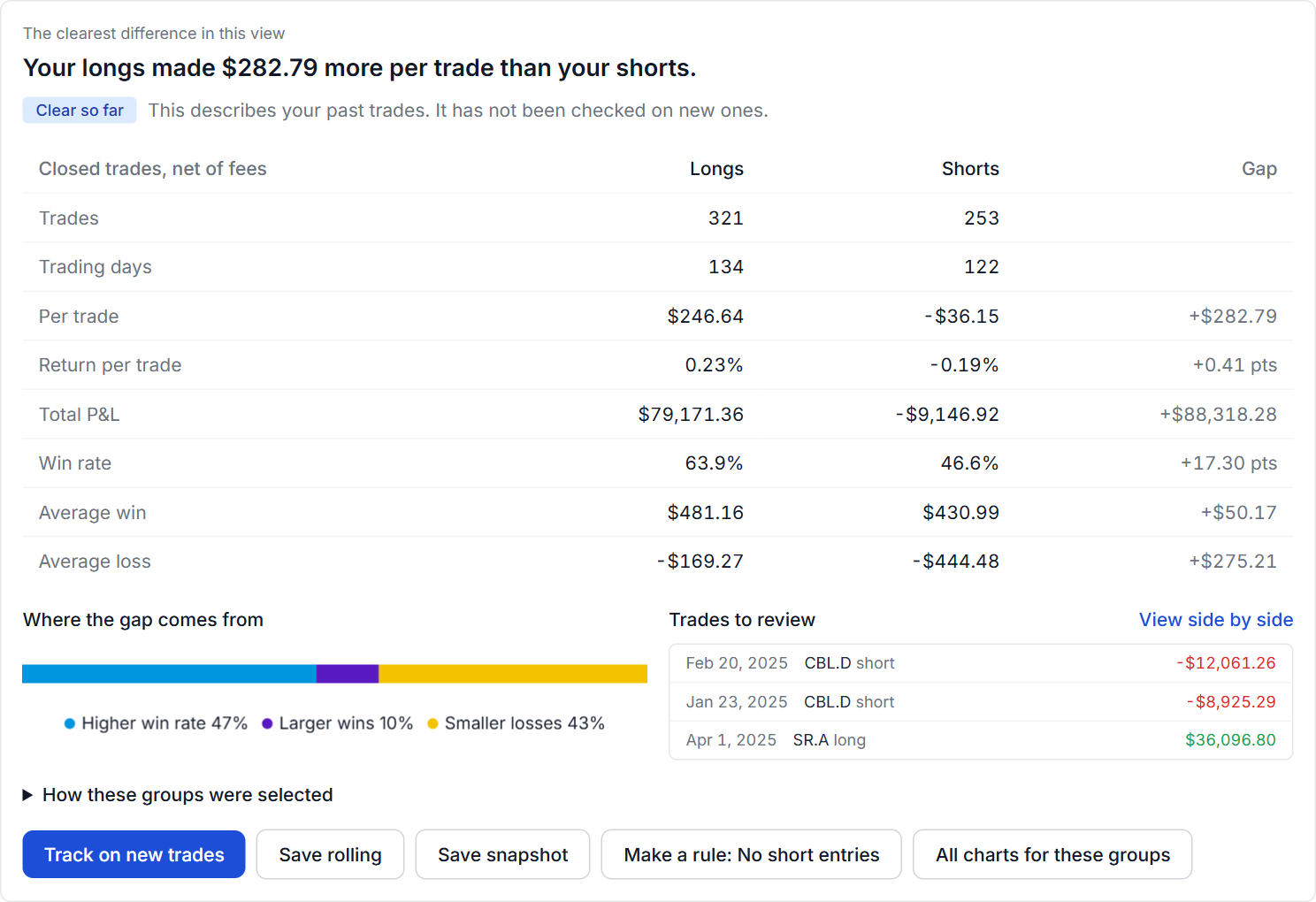
Every answer has the same parts, from top to bottom:
- The headline says which group did better, and by how much per trade.
- The label says how much weight that gap can carry. See the next section.
- The table shows both groups: trades, trading days, per trade result, return per trade, total P&L, win rate, average win and average loss.
- Where the gap comes from splits the per trade gap into win rate, win size and loss size. In the example above, most of the gap comes from a higher win rate and smaller losses, not from larger wins.
- Trades to review lists the three trades that did the most to open the gap: two from the weaker group and one from the stronger group. Click one to open it in Trade Explore.
- How these groups were selected shows the exact definition, the dates and how much of the data was usable.
- The buttons let you save or open full charts. Eligible prepared answers also offer tracking or a rule draft.
What the labels mean
Any two groups of trades will have different averages. The label tells you whether the gap stands out from your normal day-to-day swings.
| Label | What it means |
|---|---|
| Clear so far | The gap stands out from your day-to-day swings, it holds in both dollars and percent return, and no single day carries it. |
| Not clear yet | There is a gap, but the page tells you why it does not stand out: it is small next to normal swings, dollars and percent return point in different directions, or most of it comes from one trading day. |
| Too few trades | Labels start at 100 closed trades in the view, with at least 20 trades on each side. |
| No label | You picked the trades or asked AI to define custom groups, or the result is arithmetic rather than a test, as in "Why did this period change?". You see the numbers without a verdict. |
Three things sit behind every label:
- Your days are compared, not just your trades. Trades taken on the same day tend to move together, so 30 trades on one good morning do not count as 30 separate pieces of evidence.
- The number of questions counts. Ask enough questions of any set of trades and something will look interesting by chance, so each label accounts for how many questions were asked. Platinum questions are held to a stricter bar, and adding them never changes the label on a core question.
- Only what was known at entry is used. Hold time and final size are left out on purpose, because a stop-out is short by definition and a scale-in changes the size after the fact.
A label describes your past trades. It does not say a difference will continue, and some differences fade on new trades. That is why the page says "Clear so far", and why tracking exists.
Every question
A question appears when you have the data behind it. Many can be adjusted: open How these groups were selected and change the setting there.
Core questions
| Question | What it compares | What you can change |
|---|---|---|
| Am I better long or short? | Longs vs shorts | Nothing to set |
| What changes after a loss? | Entries after a closed loss in the same session vs other entries | Same session, within 30 minutes or within 5 minutes |
| Am I improving? | Your last 20 sessions vs the previous 20 | 10, 20 or 40 sessions |
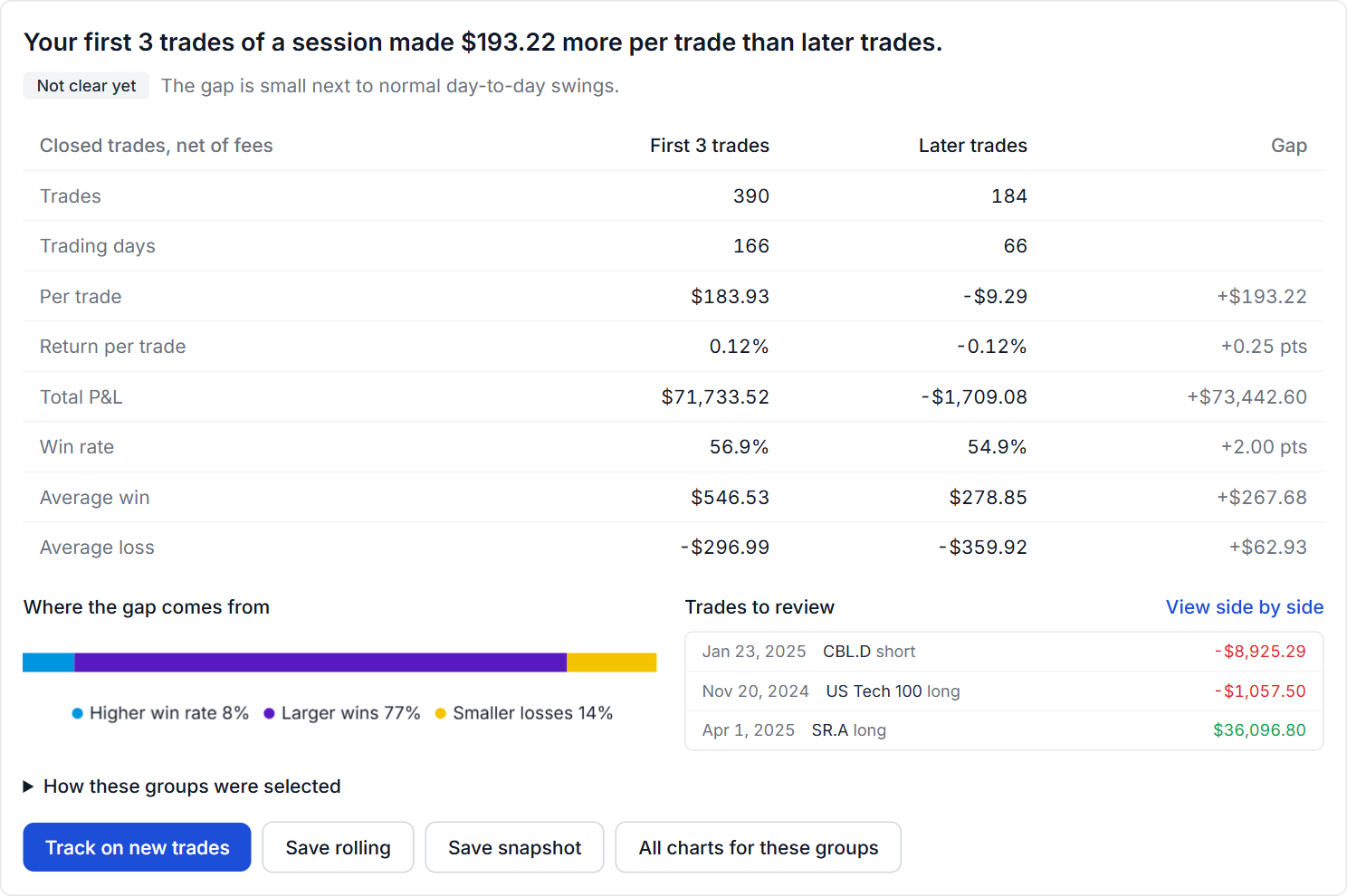
| Does trading more help me? | Your first 3 trades of a session vs later trades | First 1, 2, 3 or 5 trades |
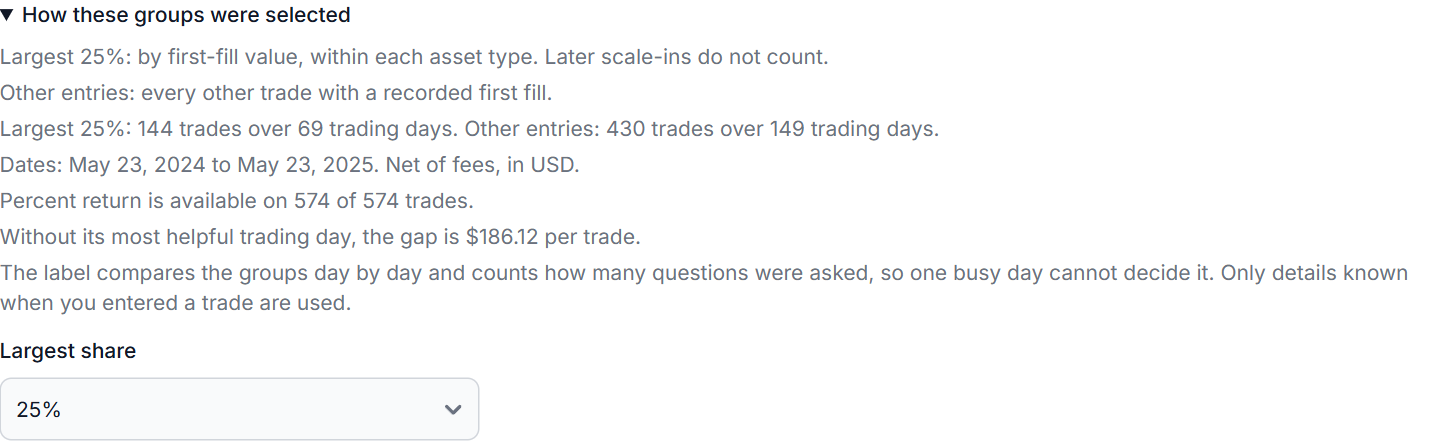
| Do my biggest entries do better? | Your largest 25% of entries by first-fill value, within each asset type, vs the rest | Largest 10%, 25% or 50% |
| How does my main symbol do? | Your most traded symbol, including its options, vs other symbols | Any of your 10 most traded symbols |
| Which setups work? | One tag vs your other tagged trades. Appears when at least 30% of your trades are tagged | Any of your 10 most used tags |
| Is one account different? | One account vs the other selected accounts. Needs two or more accounts | Any of your 10 largest accounts |
| When do I trade better? | Entries before 12:00 vs from 12:00, in your timezone. If nearly all your entries fall on one side, the split moves to the middle of your own day | The split time, in 30 minute steps |
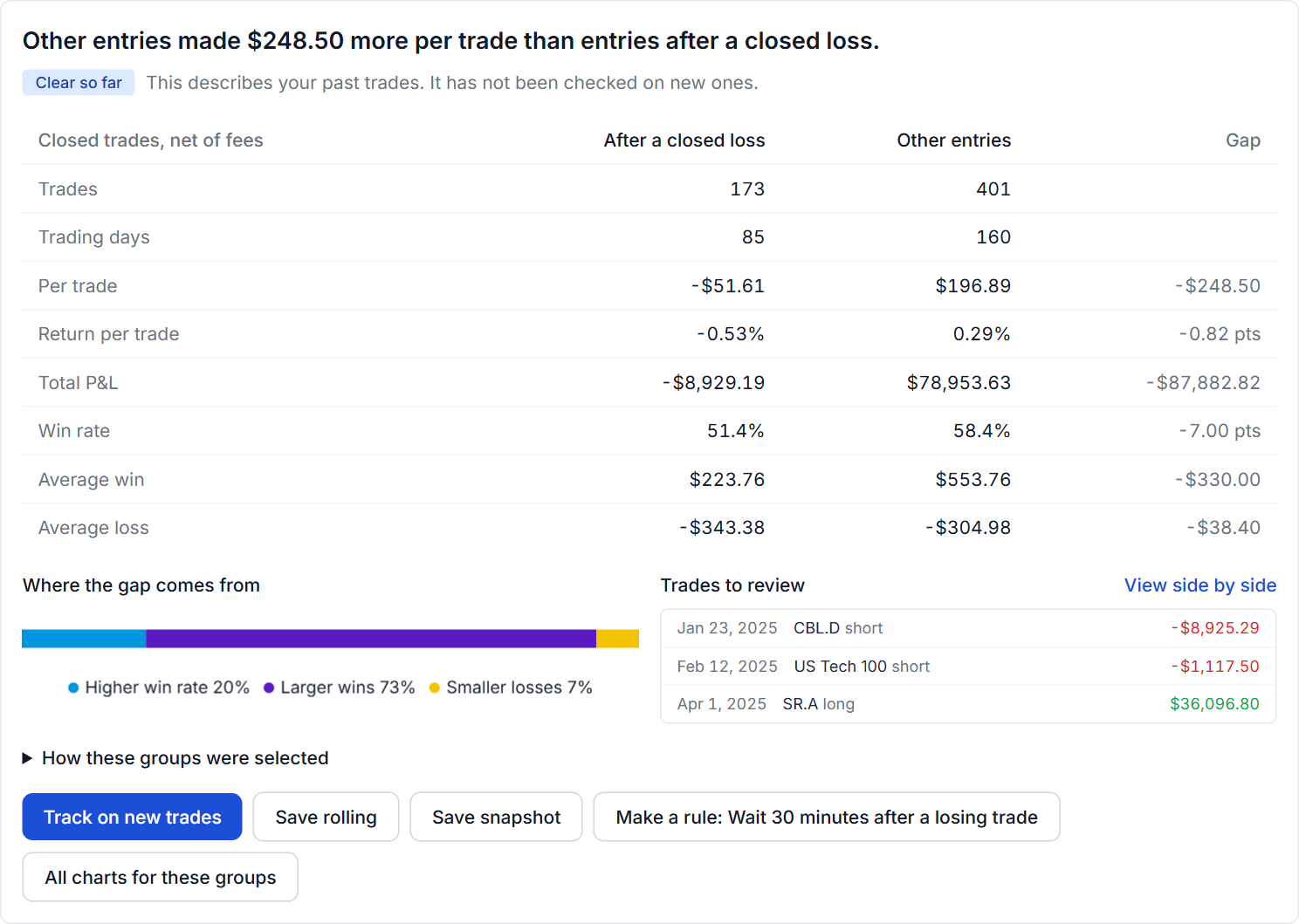
"What changes after a loss?" describes order only. It shows that an entry came after a closed loss, not why you took it.
If you change a definition, the answer says so, because the more settings you try, the more likely one looks good by chance. Back to the standard definition resets it.
Platinum questions
| Question | What it compares | What you can change |
|---|---|---|
| Do I follow my plan? | Trades where you followed your plan vs trades where you broke it | Nothing to set |
| Did my rule help? | Days you kept a rule vs days you broke it | Any of your rules |
| Does practice carry over? | Live trades vs simulator trades in the same symbols | Nothing to set |
| Do option expiries matter? | Options with 7 days or less to expiry vs longer dated options | 0, 1, 7 or 30 days |
| Do conditions matter? | Entries with SPY above its 20-day average vs below it | SPY, QQQ, IWM or NSEI |
| What did my exits cost? | Your exits vs holding the same trades to the session close | Nothing to set |
| Why did this period change? | Your last 20 sessions vs the previous 20, split into parts | 10, 20 or 40 sessions |
The Platinum questions in detail
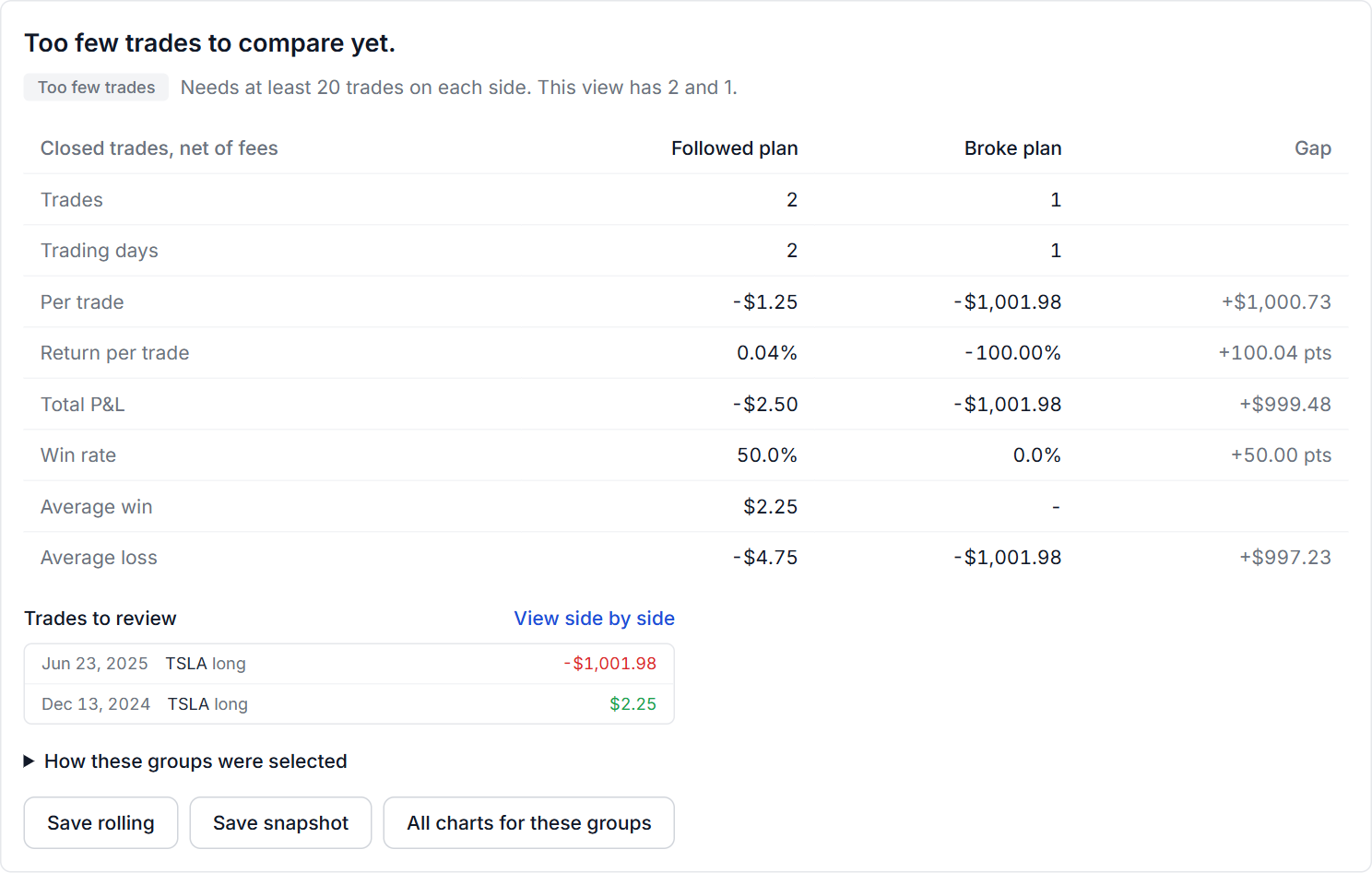
Do I follow my plan?
This reads the checklists on your trading plans. A trade counts as followed when every answered checkbox is ticked, and as broken when at least one is left unticked. Trades without an answered plan are left out. Plans are often filled in after a trade, so this answer can reflect hindsight.
Did my rule help?
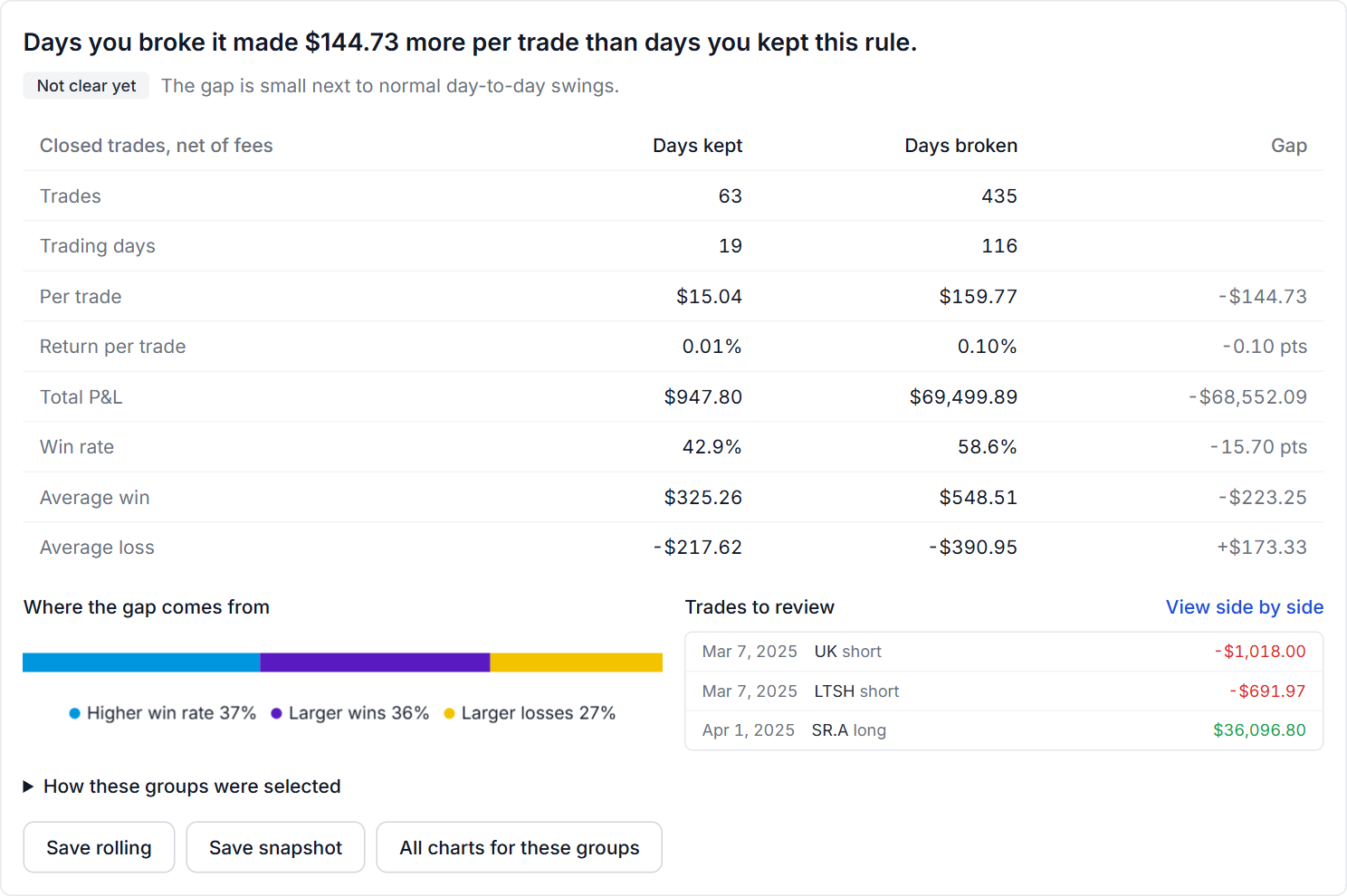
Pick any of your Trading Rules and compare the days you kept it with the days you broke it. Rules about the result itself, such as finishing the day green, are left out, because a good day keeps them automatically. A rule is scored after the day ends, so this can still reflect how the day went.
Does practice carry over?
This compares your live trades with your simulator trades, using only symbols you traded in both. It needs both a live account and a simulator account in the view.
Do option expiries matter?
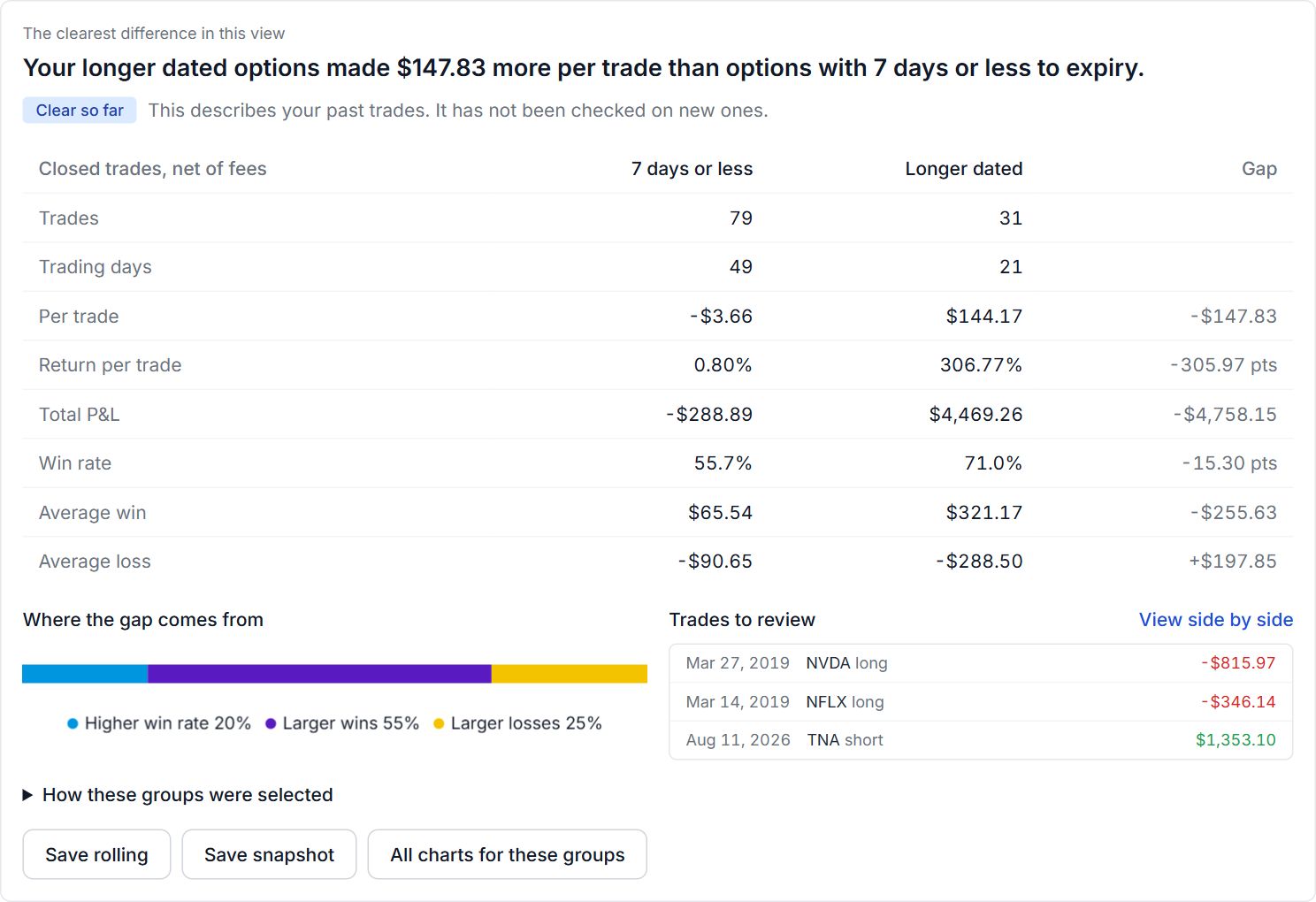
This groups your option trades by days to expiry at entry and leaves stock and futures trades out. It appears once you have at least 40 option trades with an expiry on record.
Do conditions matter?
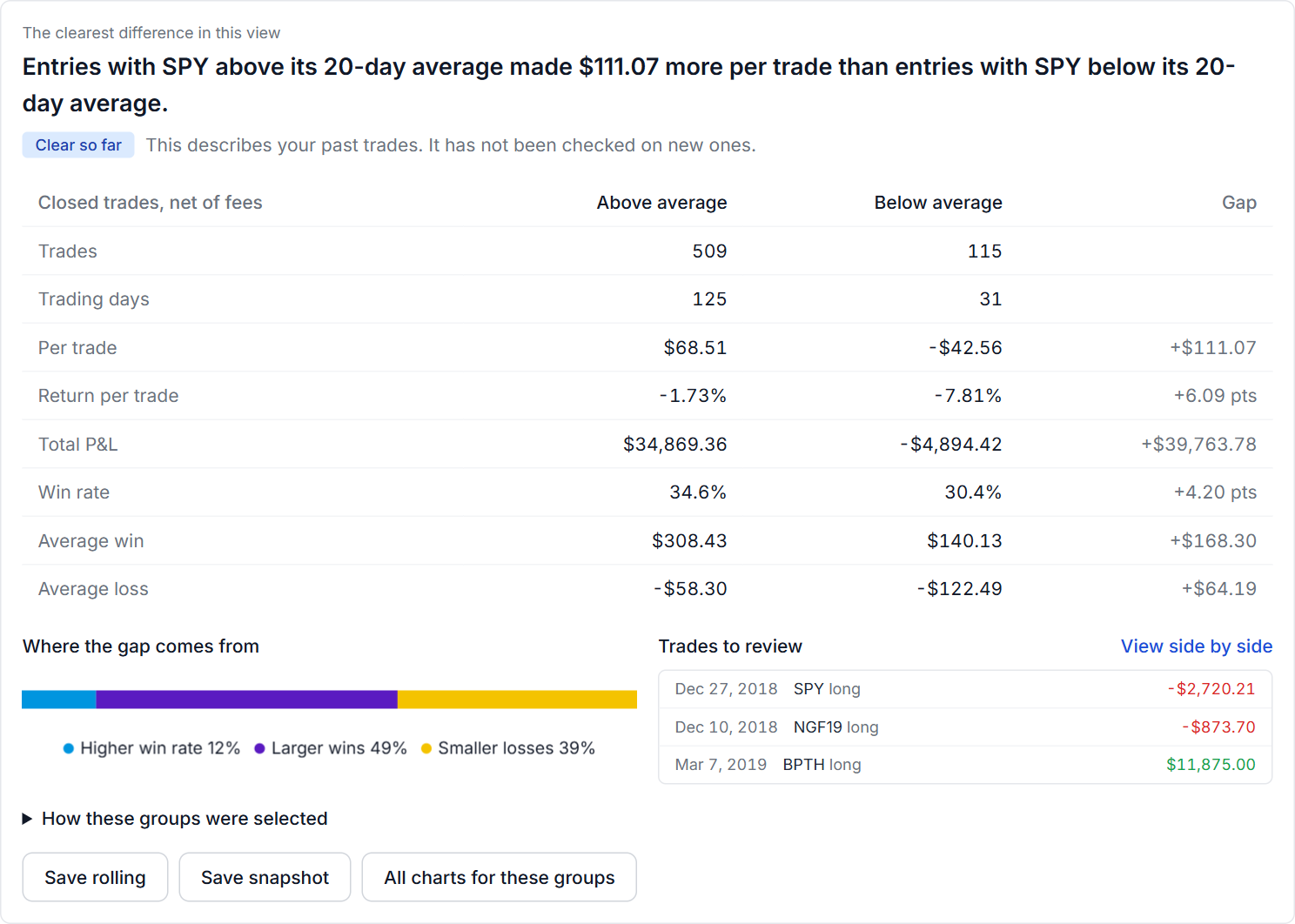
This splits your entries by whether the market closed above or below its 20-day average in the session before you entered. Only the previous close is used, so it was known when you took the trade.
What did my exits cost?
This prices the same trades twice: once at your real exit, and once at that session's close. It covers trades that opened and closed in one session, before fees, and it needs at least 20 trades with end-of-session prices. Where best exit prices are available too, it also shows what the same trades would have made at the best exit. That is hindsight, so read it as a ceiling. The exit analysis charts go deeper on single trades.
Why did this period change?
This splits the change in your total P&L between two stretches of sessions into parts that add up to the whole change: more or fewer trades, larger or smaller entries, better or worse return on size, and higher or lower costs. It also lists the symbols that moved the most.
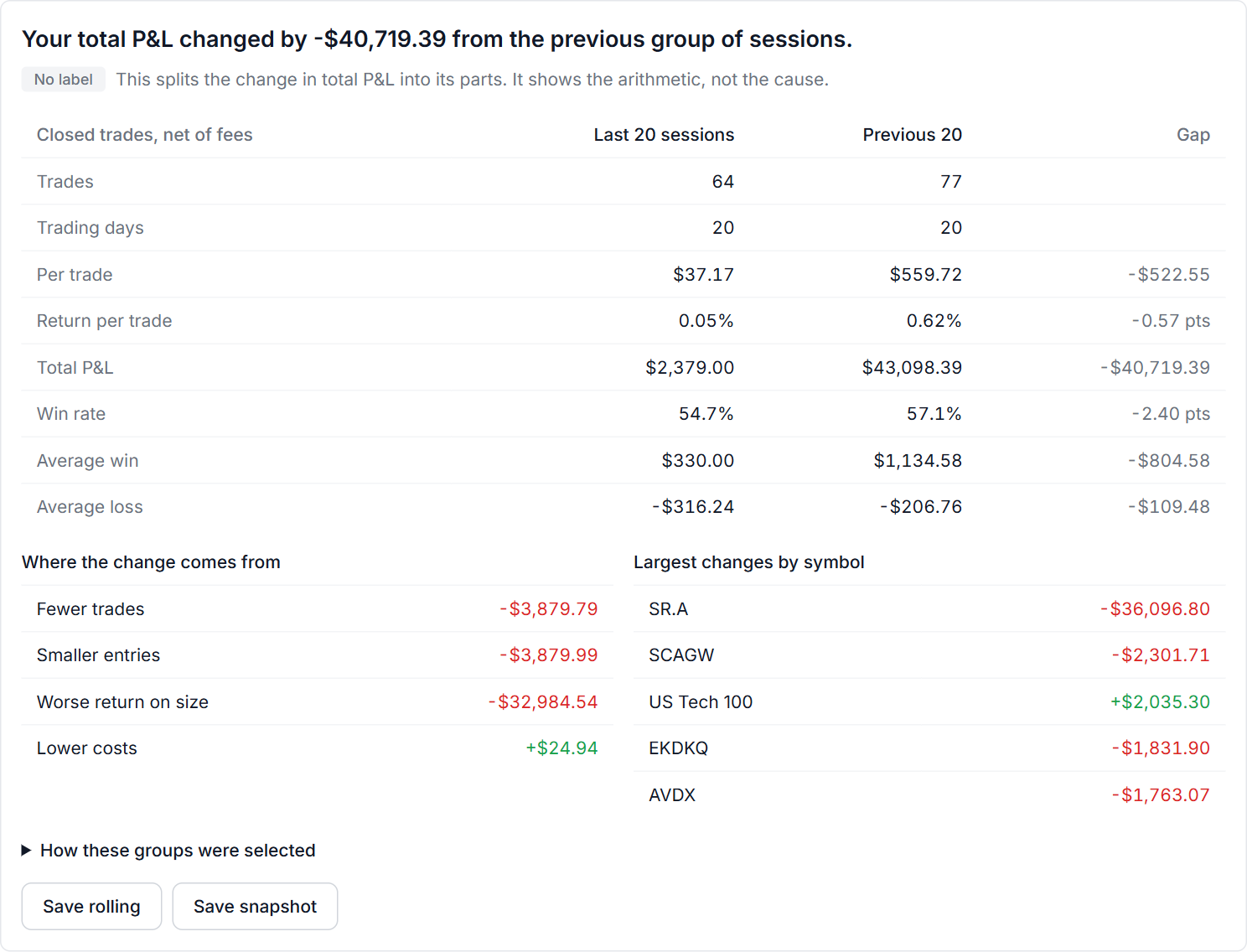
It has no label because it is arithmetic, not a test. It shows where the change sits, not what caused it.
Tracking a comparison on new trades
A label looks backward. Tracking looks forward. Click Track on new trades and Compare freezes the exact definition, then judges it only on trades you open from that point on.
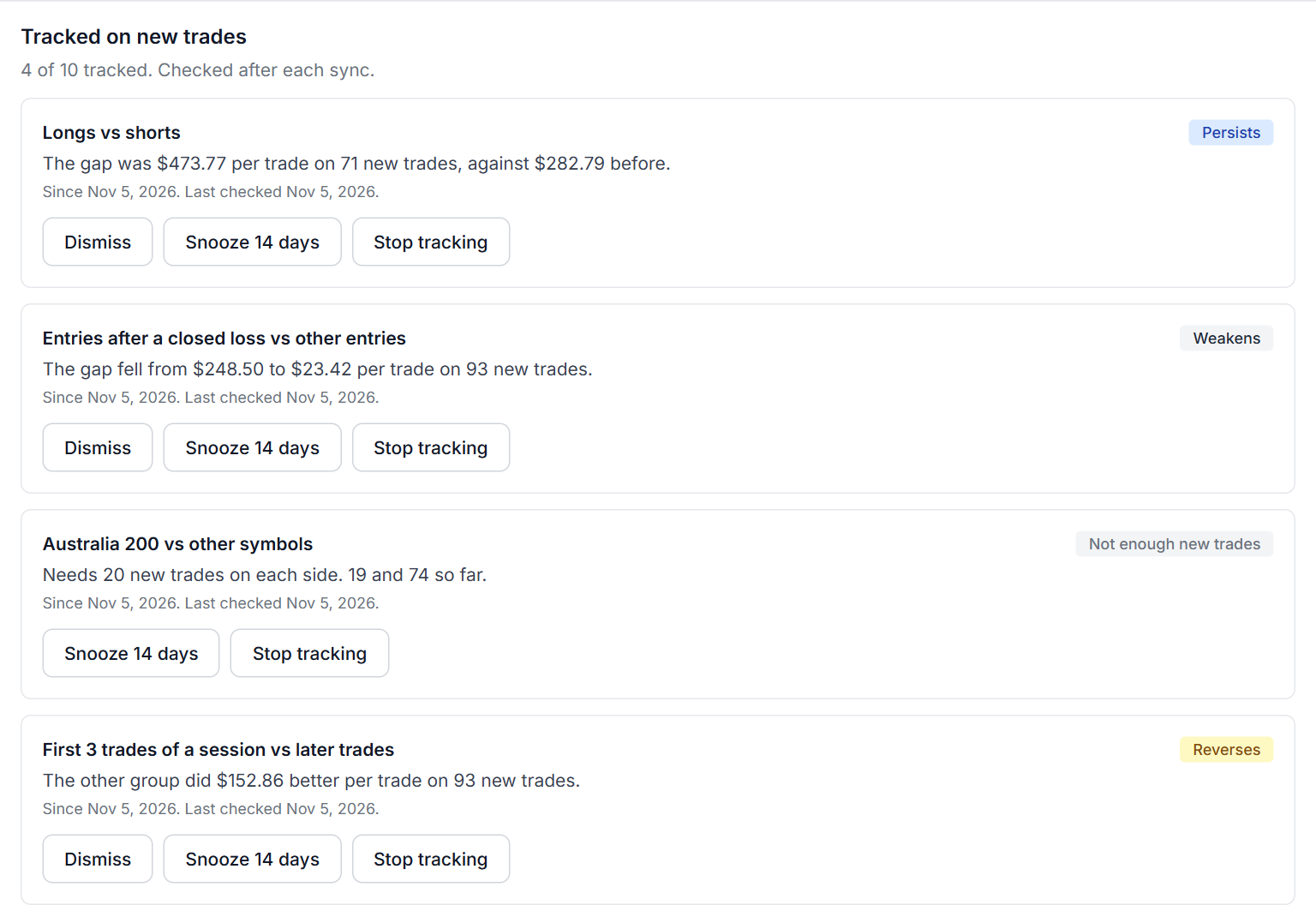
| State | What it means |
|---|---|
| Not enough new trades | Fewer than 20 new trades on one side so far. It shows the count on each side. |
| Persists | The same group is ahead, by at least half the original gap. |
| Weakens | The same group is ahead, by less than half the original gap. |
| Reverses | The other group is now ahead on new trades. |
Platinum comparisons are checked after each sync, and Pro comparisons weekly. Compare only tells you when a state changes, never just because an import finished. When one does, a dot appears next to Compare in the sidebar and a line appears in your AI Daily Brief. You can dismiss it, snooze the comparison for 14 days or stop tracking.

You can track any core question except "Am I improving?", which compares two stretches of time, so new trades cannot join either group. Comparisons opened from an AI Coach Trading Review card can be tracked too. The Platinum questions and custom AI-assisted comparisons cannot be tracked yet.
Saved reports
Prepared answers and AI-assisted comparisons can both be saved. Your reports live in Tracked and saved:
- Save rolling keeps the question, group definitions and view settings. Each time you open it, it uses your latest matching trades. A rolling period moves forward; an explicit year such as 2023 stays fixed.
- Save snapshot keeps the exact numbers from that day. They never change, which makes snapshots useful for a before and after, or for a monthly review.
Each report card shows trade count, win rate and total P&L for both groups, so you can scan several comparisons before opening one. Rolling cards refresh their stats from the latest matching trades. Snapshot cards keep the stats you saved.
For example, save a rolling report for your SPY morning-versus-afternoon comparison to revisit it as trades arrive. Save a snapshot at the end of a review to keep that day's numbers. Reopening either report uses the saved definitions and does not make another AI request.
Trades side by side
Click View side by side above Trades to review, or select trades in a table and choose Table Actions > Compare Selected. The trades open as columns with side, open and close times, time held, entry, exit, size, fills, P&L, return, commission, fees, stop loss, profit target, R, tags and notes.
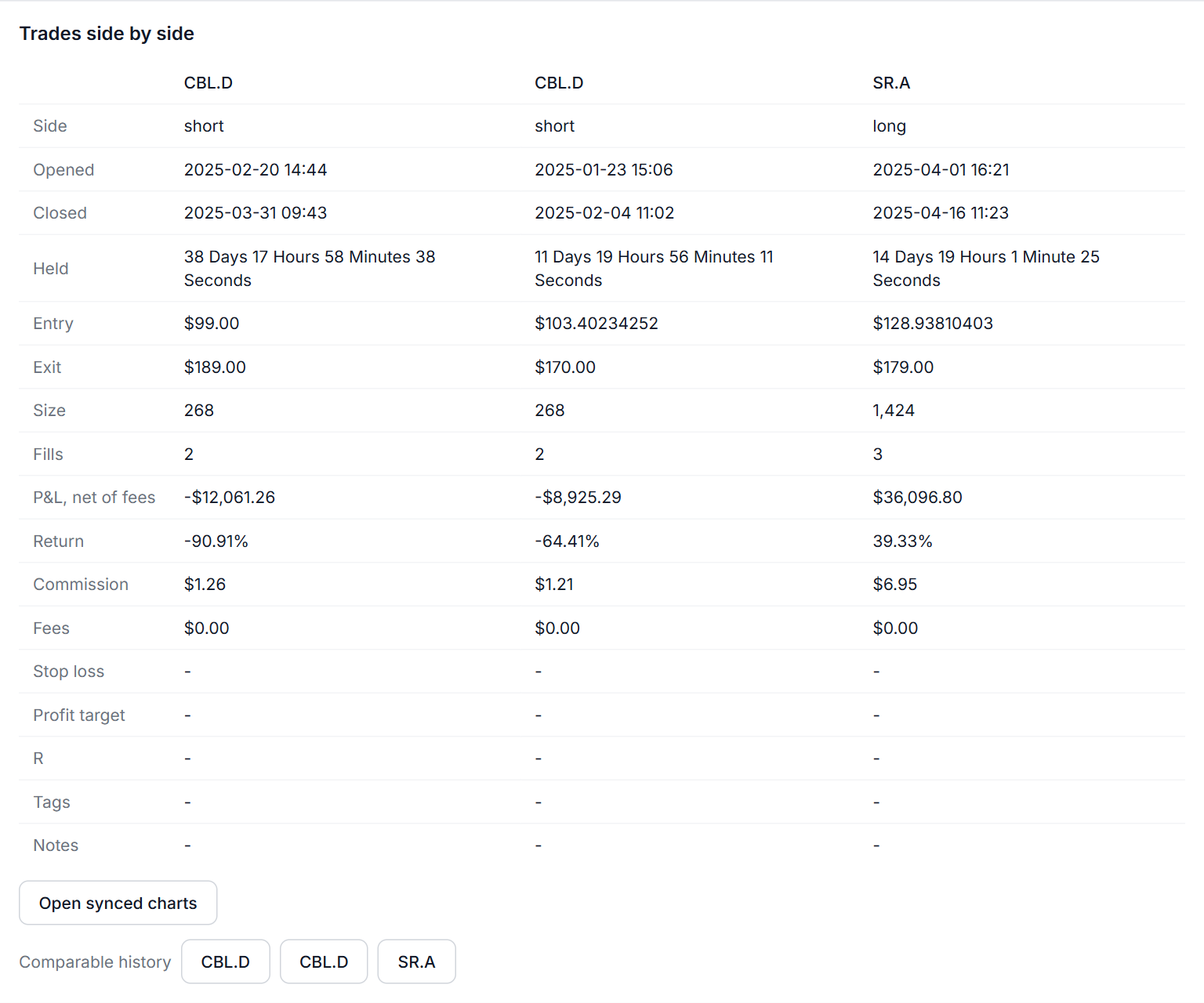
Pro shows 2 trades side by side and Platinum shows 4. On Platinum, Open synced charts opens the trades together in Chart Trades, one chart per trade.
Selecting 5 or more trades in a table, up to 200, compares them as a group against the rest of your trades. You chose those trades yourself, so that result shows numbers with no label.
Comparable trades
Was that loss unusual for you, or normal for this kind of trade? On Platinum, click Comparable Trades in Trade Explore, or a symbol under Comparable history in the side by side view.
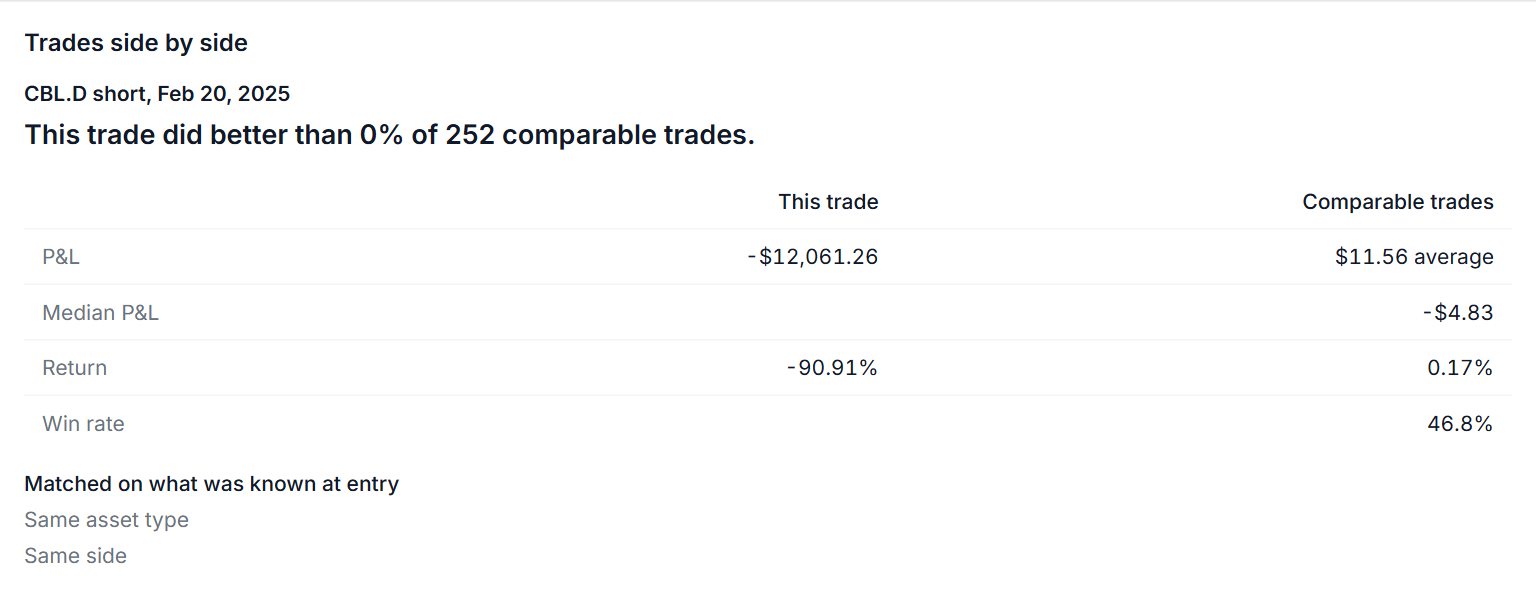
Compare matches on what you knew at entry, starting strict and widening only until it has at least 10 trades from the same account:
- Same symbol, same side, entered within an hour of the same time of day, and first-fill value between half and double this trade's.
- The same, without the size match.
- Same symbol and same side.
- Same asset type and same side.
The answer lists the match it used, so you can see how close the comparison is.
Turning a result into a rule
When a difference is Clear so far and a rule can state it exactly, a Make a rule button appears with a draft such as No short entries, Wait 30 minutes after a losing trade or At most 3 trades a day. Clicking it adds the rule to Trading Rules, where you can edit or delete it.
Rules that apply to one group of trades, such as one side or one symbol, are part of Platinum. Rules that cover all your trades work on Pro.
All charts for these groups
Click All charts for these groups to go from an answer to the full analysis. Compare turns both groups into filter groups, using the exact trades from the answer, and generates the same charts you use in your dashboard, with both groups plotted together.
This works for prepared questions and AI-assisted comparisons. The charts use the groups you just reviewed.
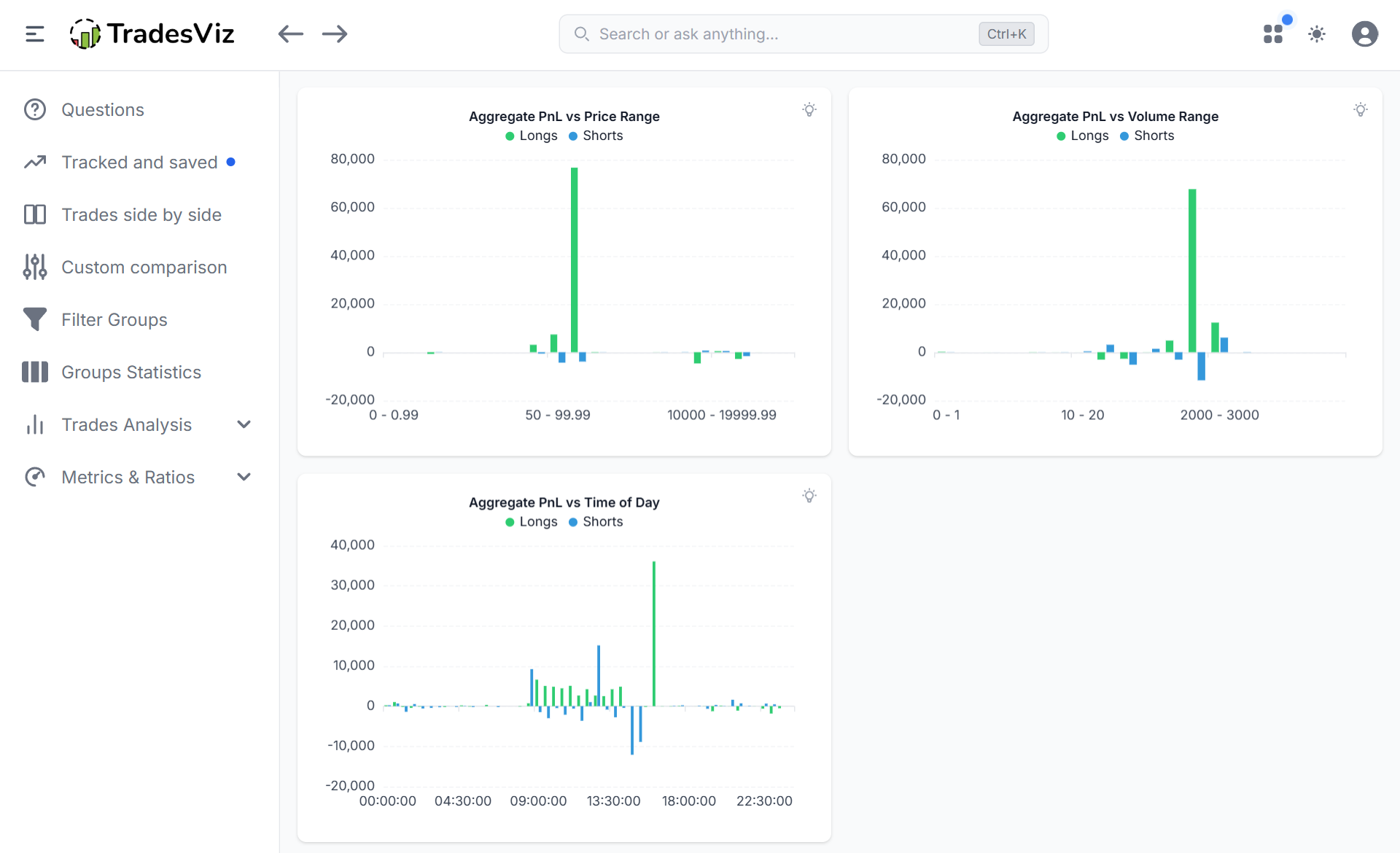
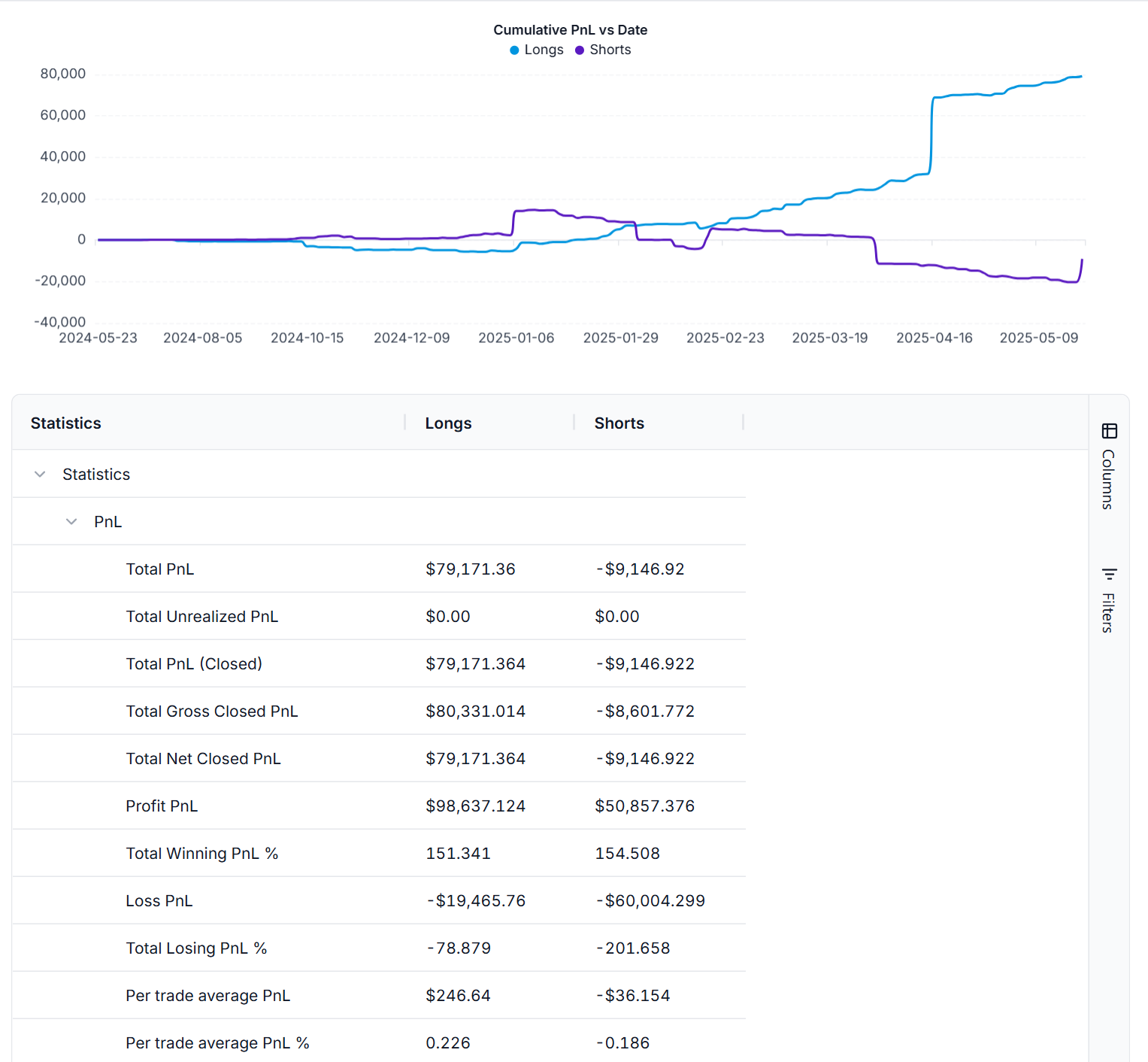
Groups Statistics then lists every statistic for each group in one table, under a cumulative P&L chart.
A chart group can list up to 5,000 trades, so on very large views Compare asks you to choose a shorter period or fewer accounts first.
Custom comparison
For direct control over filters, or to compare more than two groups, use the manual builder. Click Custom comparison at the top of the page or in the sidebar. You get around 20 filters, including accounts, asset types, position, day and time, price, volume, duration, tags and sectors.
- Set your filters, give the group a name and a color, and click Add Filter Group.
- Repeat for each group you want to compare, up to 10.
- Under Charts to generate, choose the chart sections you need. Fewer sections generate faster.
- Open Filter Groups and click Generate Comparison Analysis.
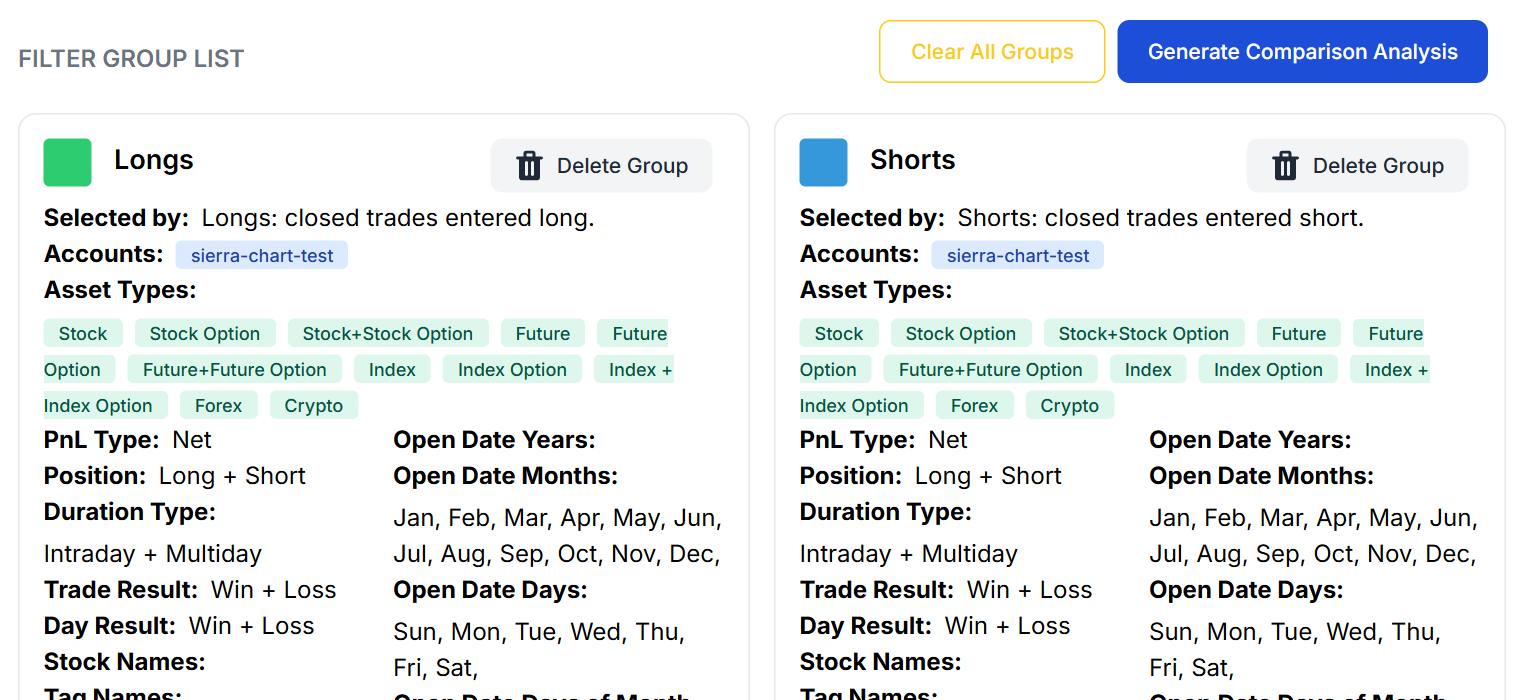
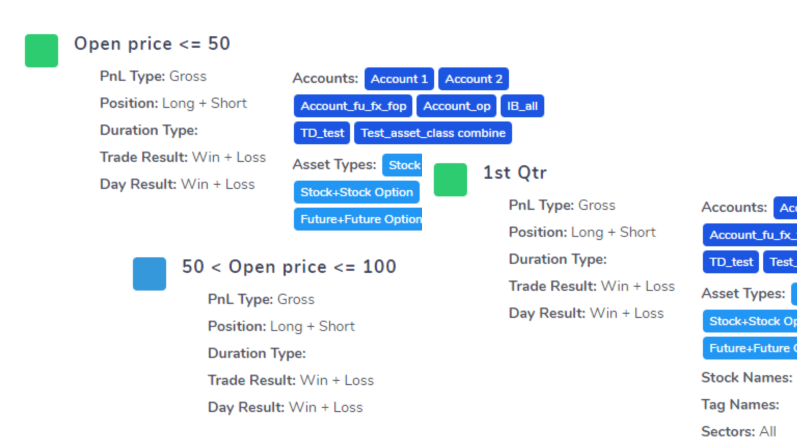
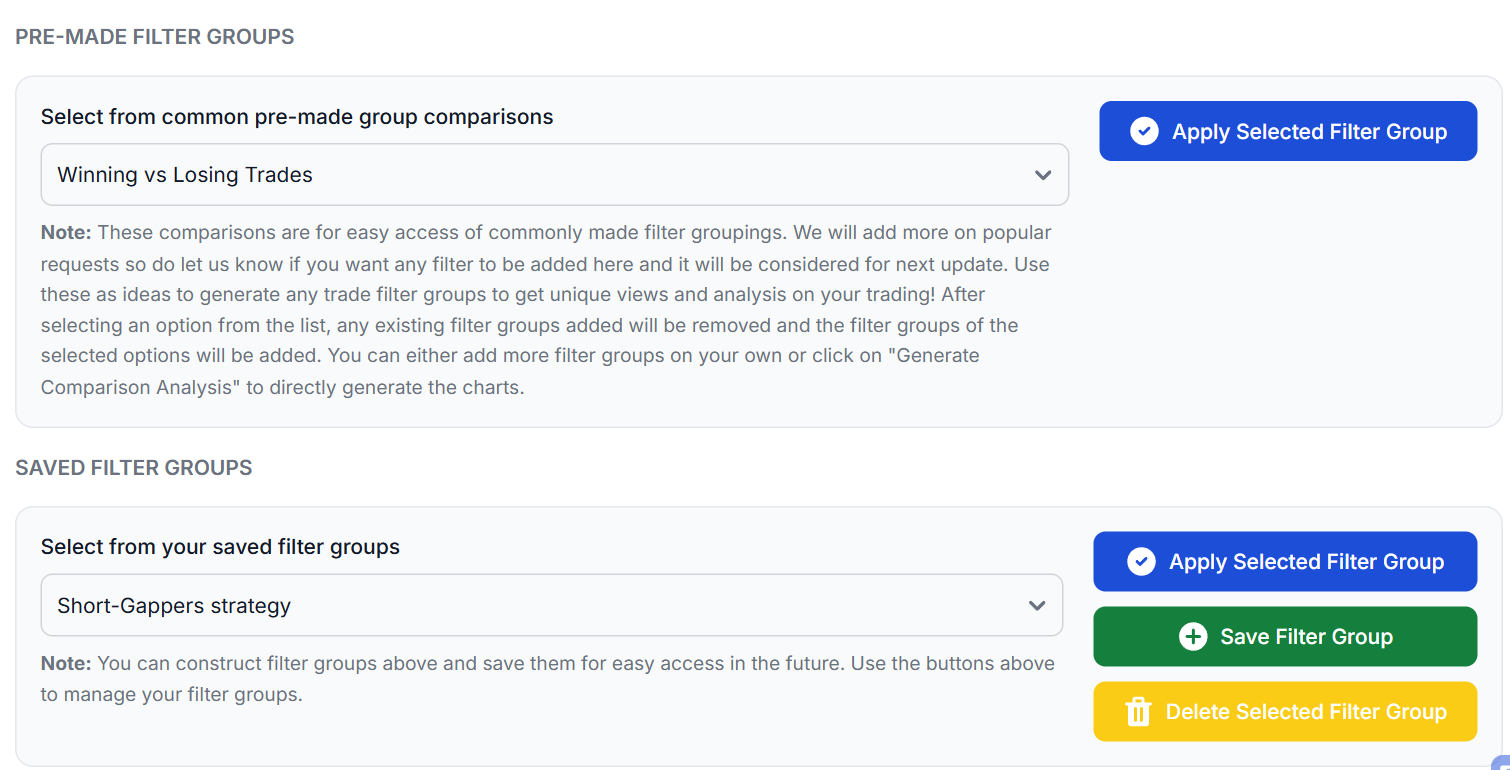
If you want a starting point, Pre-made filter groups has 8 ready comparisons: winning vs losing trades, winning vs losing days, long vs short, last vs current trading year, intraday vs multiday, Monday vs Wednesday vs Friday, the four quarters, and price ranges under 50, 50 to 100 and over 100. Groups you build often can be kept under Saved filter groups.
Custom comparisons show charts and statistics without a label, because you chose the groups. As with your dashboard, you can click any point on a chart to explore the trades behind it.
Compare from the rest of TradesViz
You do not have to start on the Compare page. A comparison is one click away wherever a question comes up.
AI Coach Trading Review
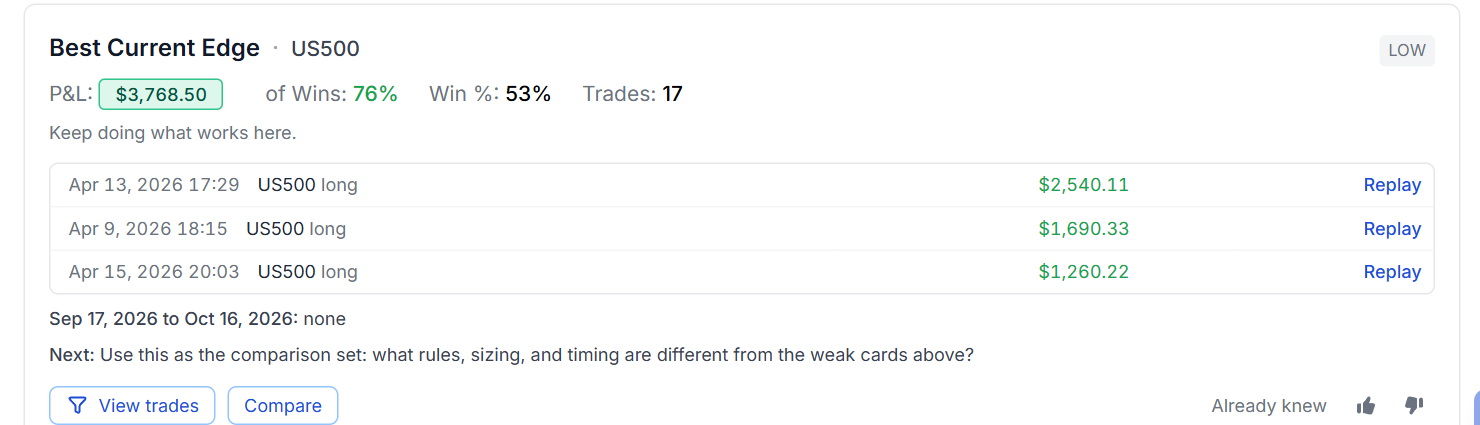
Cards in AI Coach Trading Review have a Compare button that sets the card's trades against the rest of the same trades. The button appears on cards about a symbol, a weekday or a time of day, because those were known at entry. A card about your losses has no fair comparison group. A card is the pick of many possible splits, so its label has to clear a higher bar than a prepared question.
Calendar
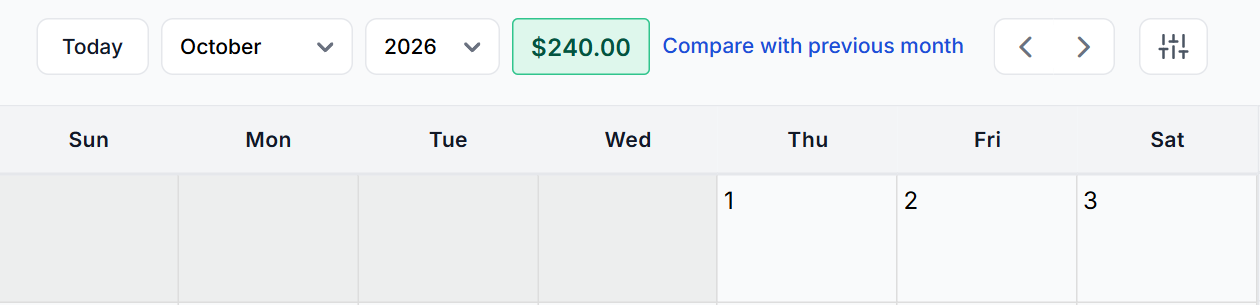
On the Calendar, Compare with previous month compares the month on screen with the month before it.
Any chart
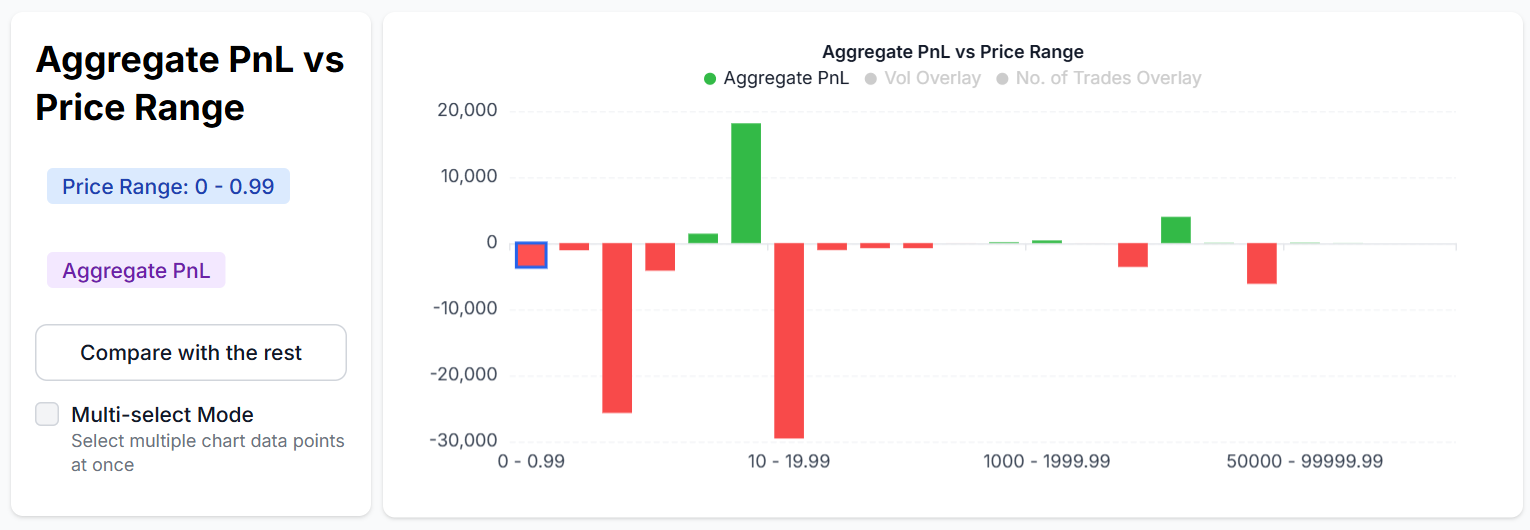
Click a point on any dashboard chart to open Chart Explore, then click Compare with the rest to set the trades behind that point against everything else. The selection stays available for an hour.
Trades tables and Trade Explore
Table Actions > Compare Selected works in your trades tables, and Comparable Trades is in Trade Explore.
AI Chat and AI Query
Ask AI Chat a question such as "am I better long or short?" and it answers with the numbers and the label from Compare, with a link to the full answer. Type a prepared comparison such as longs vs shorts into AI Query and it takes you to the matching question. To describe your own two groups, use AI-assisted comparison on the Compare page.
What Compare counts
- Closed trades only. Open positions are left out, and a trade with no P&L never counts as zero.
- Your session days. Days follow your timezone and session settings, so an overnight futures session stays one day.
- First-fill size. "Largest entries" uses the first fill, so later scale-ins do not count.
- Your newest 50,000 trades in a view, on very large accounts.
- Tags can reflect hindsight. Tags can be added after a trade closes, and the answer says so.
If a question is missing, it usually means the data behind it is missing too. "Which setups work?" needs tagged trades, "Do I follow my plan?" needs answered plans and "Did my rule help?" needs rules with scored days. Importing your full history gives every question more to work with. See our import guide to get started.
Sign up for TradesViz and see what your own trades have to say.
Trades Compare has been shaped by your feedback since 2020. If there is a question you want Compare to answer, email us at [email protected] or use the contact form. TradesViz is the all-in-one trading journal for performance analysis and journaling, and that would not be possible without our users' feature requests.