6 years. 200,000+ traders. 100,000,000+ trades processed. 250+ brokers.
Our 4th annual State of Trade Journaling Report is out.
This year: why there are suddenly 40 journals, why "dump my data into AI" will never work, and why the chart you check most is statistically meaningless.
Options flow shows heavy concentration in Technology and Semiconductors with $MU and $SNDK leading premium volumes above $400M each.
Sector Dominance: Technology captured $2.03B premium in table1 and $2.09B in, dwarfing Financial at $437M and Consumer Discretionary at 290M.
Industry Premium: Semiconductors posted $986M total premium with 3493 sweeps and 3808 splits.
Top Symbol Inflow: $MU recorded $471M total premium and 1153 sweeps outpacing SNDK at $276M-$299M.
Earnings, IPOs, Splits, Events - all in a single tab: TradesViz's day explore.
Today's earnings include $ABBV $XOM $CVX + more!
Your entire daily plan in ONE page 👇
Following the saying that there's always a bull market somewhere 😂, here are some symbols worth looking: $ACT $CHEF $CTAS
Also, from our linear reg + CCI screener combo:
$FBRX $GEF $GM + more!
If you wanted a single table that can answer most of your trading optimization questions, here it is 👇
It lives in the Exit Insights tab in your TradesViz dashboard.
Import your trades and study them this weekend.
It's worth it :)
🛑 Stop leaving massive profits on the table.
Review your data to uncover hidden execution flaws.
Exit Insights compares actual performance against optimal hold times.
Discover precise segments where early sells cost you dearly.
Maximize future returns using deep historical data analysis now! 📈
Trading $NVDA without analyzing core earnings metrics? 📈
Examine wall street revenue projections before placing orders.
Study quarterly margin shifts alongside analyst target revisions.
High-level financial research shouldn't sit behind costly paywalls.
Access this complete fundamental suite free today! 🆓
Check your screeners from anywhere using TradesViz.
Fully mobile and tablet responsive.
Everything you need at your fingertips: professional analytics and features that matter.
What's your trading plan today?...
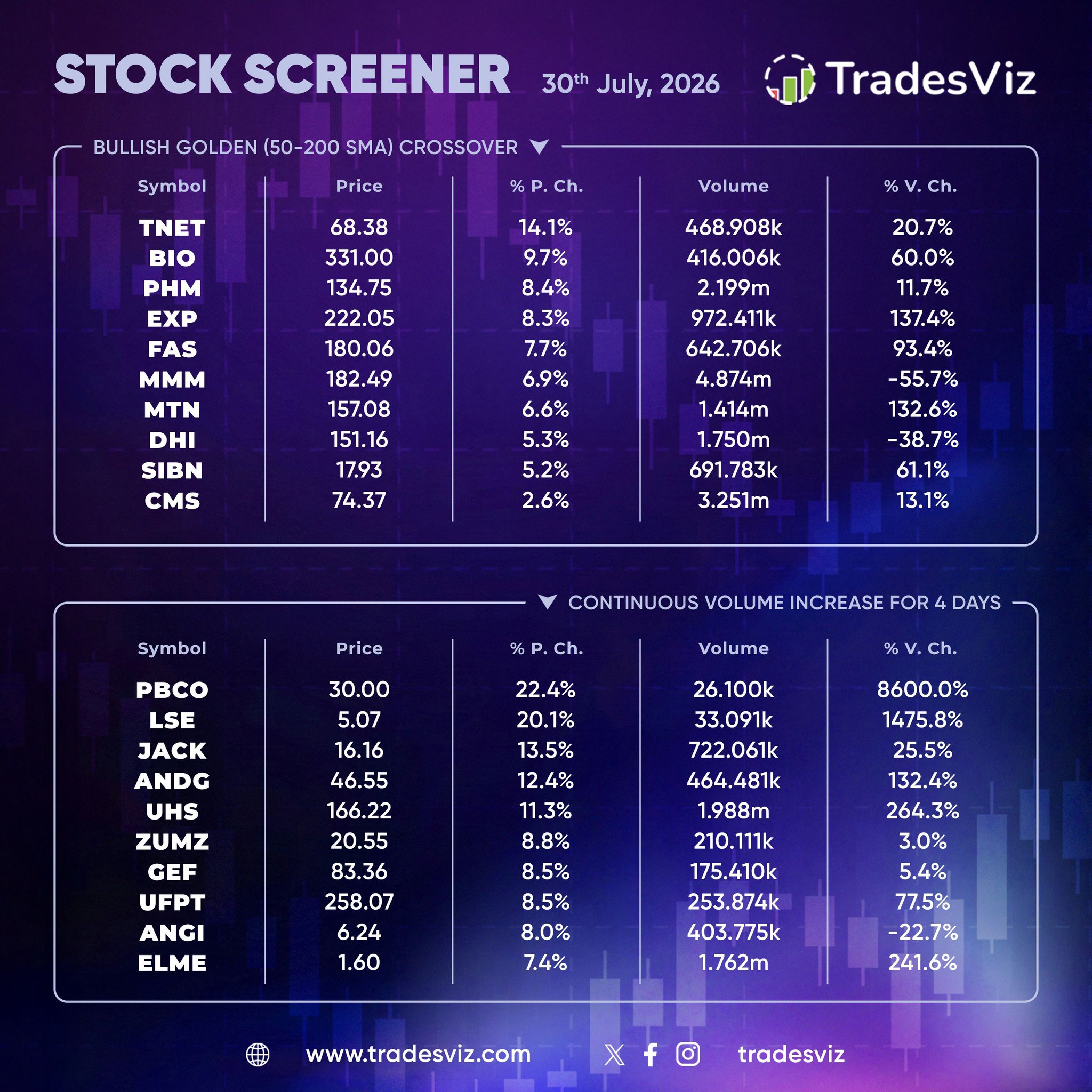
Technical strength broadened on July 30 as fresh bullish trend signals emerged across multiple sectors.
$TNET led the list of new 50 to 200 SMA golden crossovers with a 14.1% gain, while $BIO, $PHM, $EXP, and $FAS also joined the group, pointing to improving longer term positioning.
A separate theme was steady participation, with $PBCO and $LSE leading stocks that recorded four straight days of rising volume.
$JACK, $ANDG, $UHS, and $UFPT also appeared, suggesting buying interest has been building over several sessions rather than arriving in a single burst.
When trend confirmation is supported by sustained volume expansion, the tape often reflects stronger conviction in positioning.